
Two of the most tradable futures on the board heading into the weekend are sitting directly on a live, two-sided headline.
Oil (CL) carries a hot war premium that the Middle East can inflate or bleed in a single Sunday-evening print, and USD/JPY now trades with Japan's Ministry of Finance as an active, unpredictable participant.
Both reopen on CME Globex Sunday at 6:00 p.m. ET into what is historically the thinnest liquidity of the week — the exact window where a headline gaps price through your stop before you can touch it. This is not a directional call. It is a risk-management call about which door potentially opens first.
CL — A Two-Sided War Premium, Not a One-Way Bid
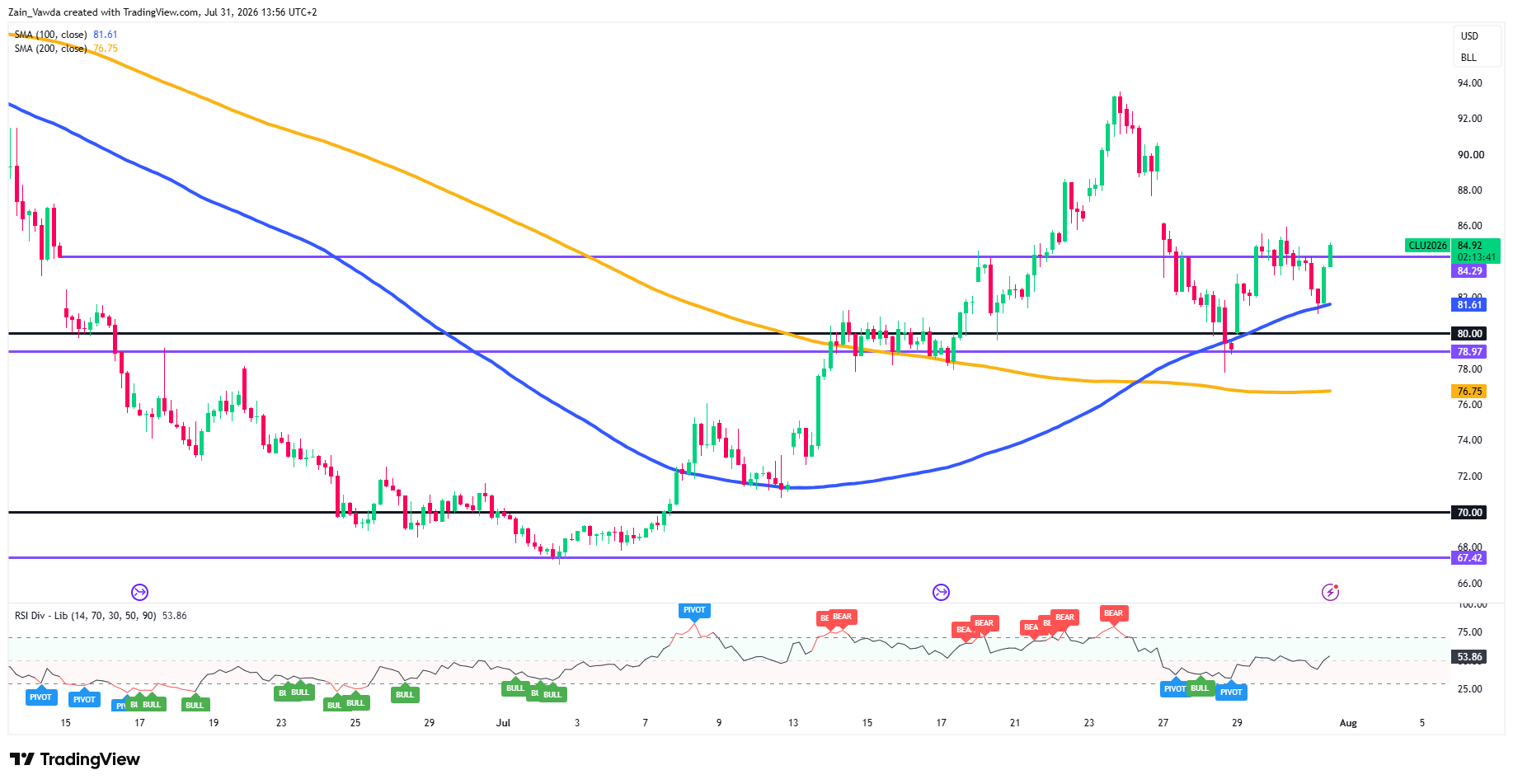
Oil is holding near $84 after a week that spanned more than an $8 range, and the US crude marker is up roughly a fifth on the month — its biggest monthly gain since March.
Oil (CL) Four-Hour Char, July 31, 2026
Source; TradingView
The bid is real: US Central Command struck dozens of IRGC sites, Iran hit a US base in Jordan, Washington has pledged retaliation, and Tehran continues to contest control of the Strait of Hormuz. Supply signals reinforce it — the Caspian Pipeline Consortium halted Black Sea loadings after tanker attacks, and the SPR has drawn for an 18th straight week to its lowest level since 1983.
The other door is just as live. Hormuz transits have already begun normalizing off last week's single-digit lows, Chinese crude inventories are ample enough to cap import demand, and any weekend ceasefire signal deflates war premium fast — this is the same energy channel that pulled June headline PCE to -0.1% m/m. Gap-up on escalation, gap-down on de-escalation: the weekend is a coin with a headline on each face.
Add to that the uncertainty of the virtual OPEC meeting scheduled for August 2. The virtual meeting is largely expected to be a formality to confirm a pre-scheduled production increase of 188,000 barrels per day (bpd) for September. This hike applies to seven core members: Saudi Arabia, Russia, Iraq, Kuwait, Kazakhstan, Algeria, and Oman.
While the August 2 meeting will likely greenlight the planned September production bump, the market's focus remains heavily on the physical supply constraints caused by regional conflicts rather than the official quotas.
6J — The MoF Is Now in the Book
The yen is the cleaner intervention story. USD/JPY (6J) plunged roughly 480 pips through 160 after Japanese authorities were reported to have bought yen and sold dollars in the New York session — dragging DXY back below 100 to a low near 99.87, its weakest since June 17.
Since 6J is quoted as yen strength, official buying spikes it up; the yen had been sitting at a 40-year low near 164 before the move, with the BoJ on hold at 1%.
The two-sidedness here is about follow-through. Thin weekend tape is precisely when the MoF prefers to act, so a fresh round can gap 6J sharply higher. But intervention without a rate catalyst behind it fades — if risk-on resumes and carry reasserts, an un-defended long-yen position bleeds back.
Korea's parallel dollar operations signal coordinated regional defense, which raises the odds of a surprise, not lowers them.
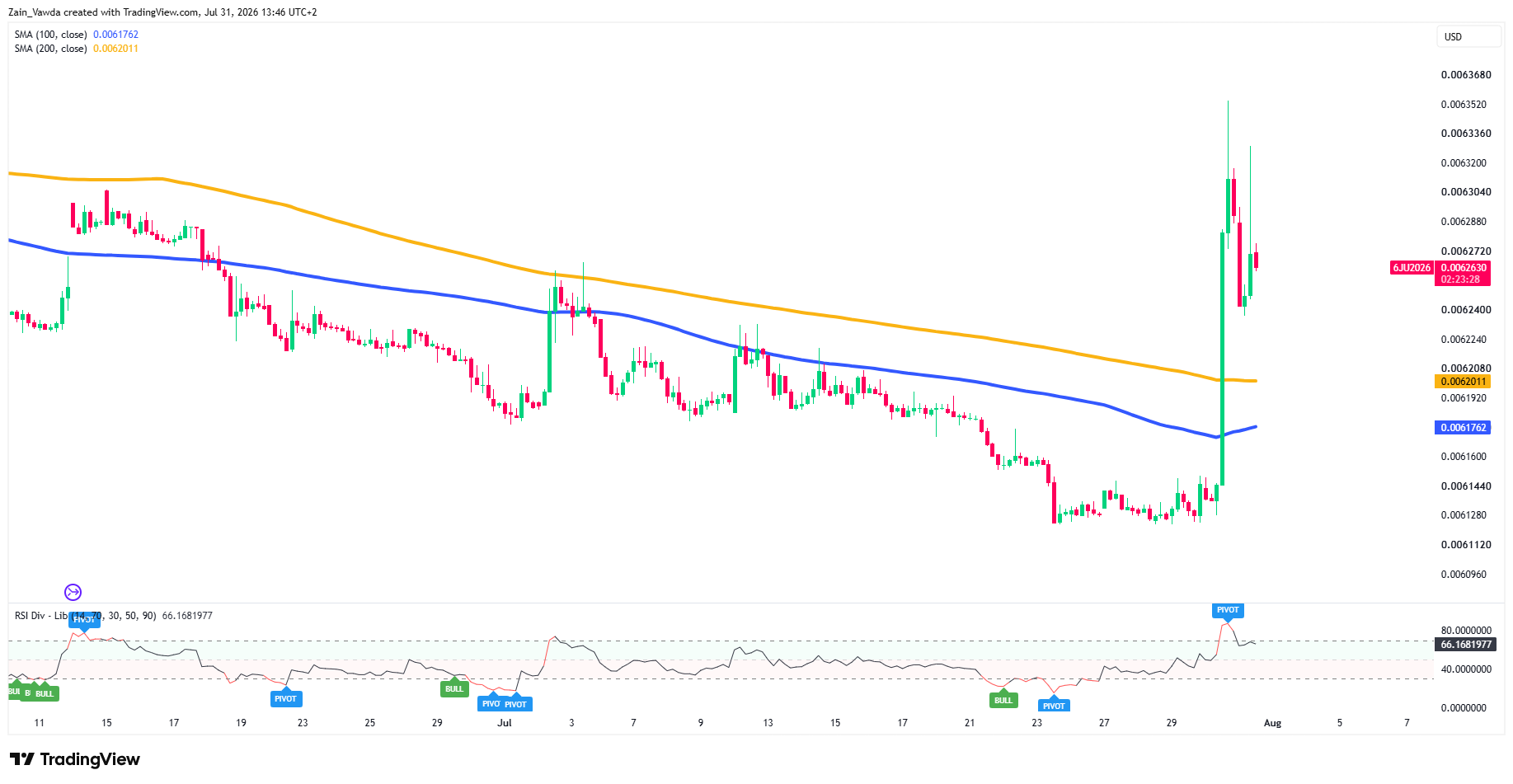
6J Four-Hour Chart, July 31, 2026
Source: TradingView
Suspected MoF intervention detonated a vertical rally off the 0.0061280 base, reclaiming both the 100-MA (0.0061762) and 200-MA (0.0062011) in a single impulse and ending July's downtrend.
Price tagged ~0.0063600, then retraced roughly half, holding the reclaimed MA confluence near 0.0062000 before rebounding to 0.0062630.
RSI printed a bearish pivot from overbought (~80) and has cooled to 66 — momentum fading post-spike, the classic follow-through question on an intervention move lacking a rate catalyst.
Resistance: the 0.0063200 shelf, then the 0.0063600 high.
Support: the 0.0062011/0.0061762 MA zone; a break re-exposes 0.0061280. Constructive while above the MAs, but respect the two-sidedness into the weekend.
Scenario Matrix — Keyed to the Sunday 6:00 p.m. ET Reopen

Source: Created by Zain Vawda Using Canva
On a weekend with both Hormuz and the MoF live, respect the two-sidedness and let defined risk — or no risk — do the work.