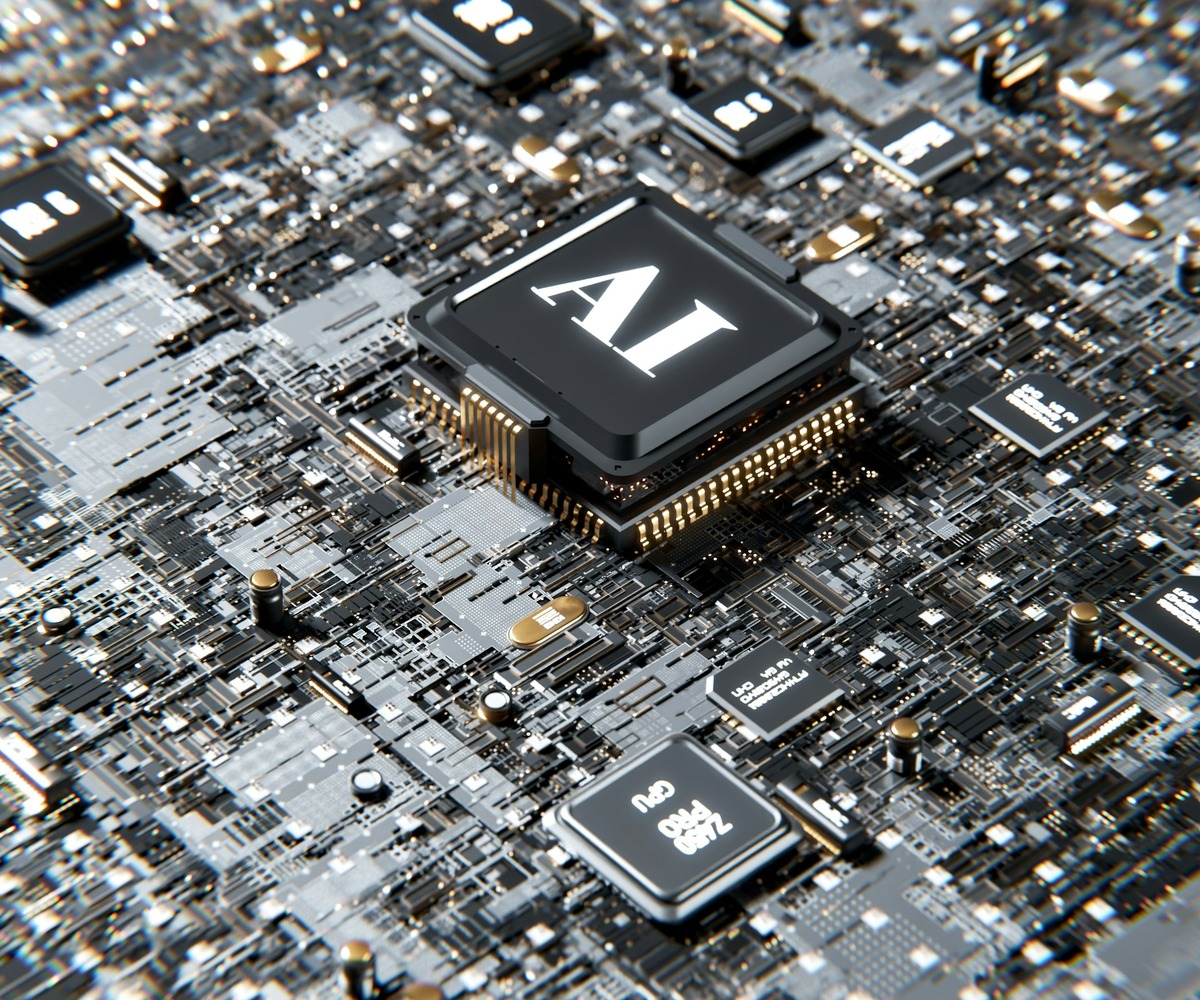
Driven by the global artificial intelligence (AI) boom, Taiwan’s stock market has surged into the world’s top tier. On Monday, the island nation overtook India to become the world’s fifth-largest equity market by capitalization. Only the stock markets of the U.S., mainland China, Japan, and Hong Kong now rank ahead of Taiwan.
According to Bloomberg data, the Taiwan Stock Exchange (TSE) reached a market capitalization of $4.95 trillion on Monday, narrowly surpassing India’s $4.92 trillion. While the gap is small in absolute dollar terms, the milestone carries significant symbolic weight, underscoring Taiwan’s growing importance in the global technology and semiconductor-driven economy.
Power Behind Taiwan’s Powerful Rally
The meteoric rise in the Taiwan stock market is closely tied to the dominance of semiconductor foundry Taiwan Semiconductor Manufacturing Co. Ltd. (TSM). The company has a roughly 42%-45% weighting in the the Taiwan Stock Exchange Capitalization Weighted Stock Index (TAIEX), which is Taiwan’s main stock market gauge.
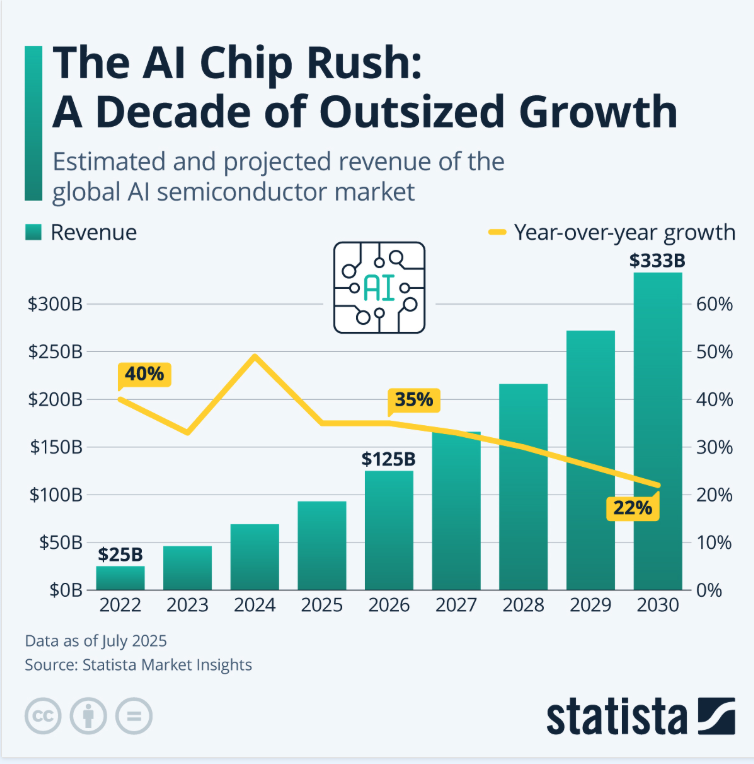
TSMC has the distinction of being the world’s largest contract chipmaker and the backbone of the global AI supply chain. It produces cutting-edge chips for global technology leaders such as Nvidia, Apple, AMD, and Qualcomm. With the rapid expansion of the AI revolution, demand for high-performance graphics processing units (GPUs) and AI accelerators has surged dramatically. Statista projects the AI chip market to hit $125 billion in 2026, up 35% year over year (YoY), with the market size expected to exceed $300 billion by 2030.
Source: Statista
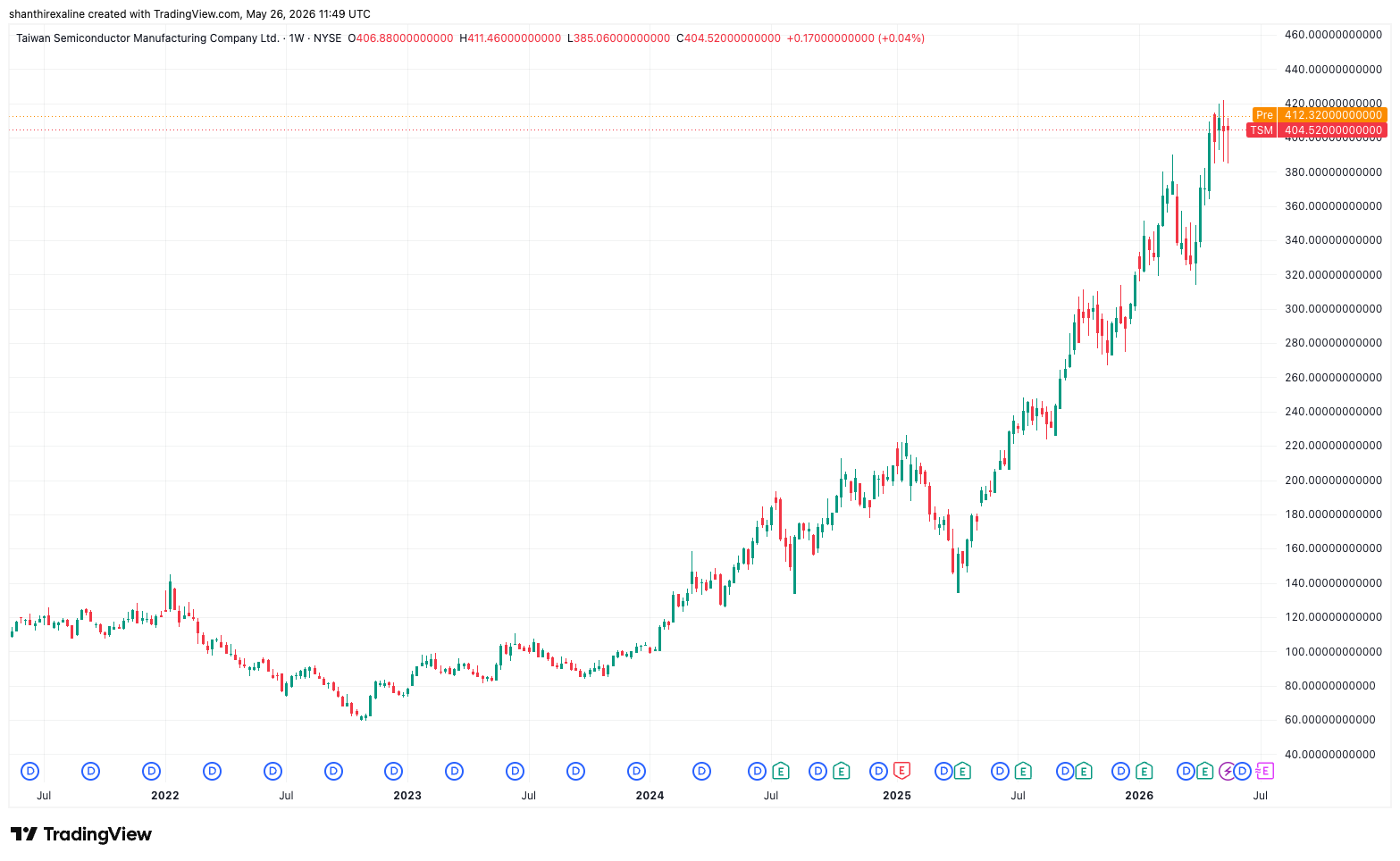
Given TSMC’s unmatched ability to manufacture advanced chips at scale, investors have rewarded the company with a premium valuation, driving its price-to-earnings (P/E) multiple above industry average. The company’s U.S.-listed shares have gained more than 33% this year.
TSMC's AI-Fueled Five-Year Moonshot
Source: TradingView
TSMC’s forward P/E ratio is currently at around 26 vs. the semiconductor industry’s 22.7. The premium valuation the company commands is not attributable to just AI enthusiasm but also to its structural monopoly. It is the only company that manufactures chips using advanced 5 nanometer (nm) and 3-nm processor node technologies at commercial scale, and therefore, has become irreplaceable.
The AI-powered rally in TSMC stock may not be done yet, at least going by what Wall Street models. The average analysts’ stock price target for TSMC stock is $465, implying nearly 15% upside from current levels. Of the 6 analysts covering the stock, five have Buy-equivalent ratings and the remaining one stays on the sidelines.
And the shift in the nature of AI demand expands the market opportunity for this chip behemoth. TSMC’s CEO C.C. Wei told investors on the first-quarter earnings call that “The shift from generative AI and the query mode to agentic AI and the command and action mode is leading to another step up in the amount of tokens being consumed.” Quantifying the growth, Wei said AI accelerators will likely increase at a mid-to-high 50% compounded annual growth rate (CAGR) in 2029.
But such heavy over-reliance also comes with significant risks for the broader market and the rest of the global markets as well. Here’s a closer look at the key risks behind the AI-driven rally in Taiwanese stocks.
US Market’s Taiwan Dependency
The risk radiates far beyond Taiwan's borders. TSMC is the invisible foundation beneath some of the largest weightings in the S&P 500 and Nasdaq 100. Nvidia, Apple, AMD, Broadcom, and Qualcomm, collectively worth trillions of dollars, all depend critically on TSMC's fabrication capacity.
A shock to TSMC doesn't stay in Taiwan. It travels instantaneously to the balance sheets and supply chains of U.S. megacaps, which means it travels to the retirement accounts of tens of millions of American investors.
A TSMC production disruption of even three to six months would halt Nvidia's GPU shipments at the precise moment hyperscalers are racing to build AI infrastructure. That isn't just a semiconductor sector problem but a market-wide earnings shock that would ripple through cloud computing valuations, AI software multiples, and the entire technology complex that now accounts for roughly a third of the S&P 500's total market cap.
The Geopolitical Risk Nobody Is Pricing
Taiwan sits 100 miles from mainland China across the Taiwan Strait, and cross-strait tensions remain one of the most consequential geopolitical fault lines on the planet. Beijing regards Taiwan as a breakaway province that must eventually be reunified with the mainland, by force if necessary, while Taipei governs itself as a fully functioning democracy with its own military, currency, and foreign policy.
China made its intention very clear even during the U.S. President Donald Trump’s recent visit to Beijing.
Neither side has blinked in decades.Yet equity markets are assigning near-zero probability to any disruption scenario. The geopolitical risk premium that logic would demand is effectively absent from TSMC's valuation.
AI Capex Cycle Risk
The entire bull case for TSMC, by extension Taiwan's market and the global stock market, rests on one assumption that hyperscaler AI capital expenditure continues at its current extraordinary pace. If AI monetization disappoints, i.e. if the return on the trillion-dollar infrastructure buildout proves slower than projected, spending dries up fast. Hyperscalers now represent 61% of TSMC’s revenue, and in the event of any setback to the AI revolution, the chip foundry would be the first and hardest hit. And because TSMC is the TAIEX, the correction wouldn't be orderly.
Natural Disaster Wild Card
Taiwan is located in one of the world's most seismically active zones. A more direct hit on TSMC's primary fabrication cluster in Hsinchu or Tainan would be a supply chain catastrophe with no short-term remedy. The geographic concentration of the world's most critical manufacturing infrastructure on a seismically active island in a geopolitical hotspot is a tail risk that markets are choosing, for now, to ignore.
TSMC's dominance is real, its moat is deep, and the AI demand driving its rally has fundamental support. But the very completeness of that dominance means that the global market has quietly built a single point of failure into its foundations. The risk, therefore, is hiding in plain sight.


