S&P 500 futures are edging higher Wednesday morning, holding Tuesday's buy-signal close above the 7,580/7,590 and keeping the 7,650 June swing high within reach.
Tuesday delivered the duration tailwind a negative headline CPI, core at 2.6%, and July hold odds now near 86% and Wednesday delivered something the index needed even more: the first earnings verdict on the AI capital-spending complex that makes up roughly 40% of the S&P 500.
ASML beat and raised its full-year guidance for the second time this year on AI chip demand, jumping 7% at the Amsterdam open and dragging the semiconductor complex higher after Tuesday's memory-chip rout.
Thursday's TSMC report remains the referee for whether the credit story stays quarantined but ASML has just delivered the opening verdict, and it favours the bulls. It answered the demand question, not the funding one.
The credit market's rebuke of the debt-funded buildout still stands.
What Actually Got Downgraded — and What Just Got Validated
S&P Global cut Oracle to BBB- on July 9, one notch above junk and the rationale reads like a memo to the entire index: projected fiscal-2027 capex of $90–95 billion against a prior $60 billion estimate, a free cash flow deficit widening to negative $42 billion, leverage crossing into the mid-4x zone, and a single customer, OpenAI, accounting for roughly half of a $638 billion backlog.
The shares sit near a 52-week low around $131.50, down 28% in a month, with the market value below the order book, though Wednesday brought a rare positive headline, with reports naming Oracle the frontrunner to build Japan's secure government cloud network.
ASML's print cuts the other way. A clear beat with guidance raised for the second time this year, driven by customers ramping AI chip production, is direct evidence the end-demand underpinning the capex is real.
Both things can be true simultaneously: the equipment layer validates the spending, while the ratings agency questions how it is financed.
That distinction is precisely what the tape has been trading — asset-light software names like Cloudflare (+18% over the month) and Snowflake (+16%) rallying while capex-heavy CoreWeave (-17%) followed Oracle lower, and Tuesday's sharp selloff among memory chipmakers giving way to Wednesday's ASML-led semi rebound.
That is not a tech selloff; it is a violent rotation inside the index, invisible at the ES level until it isn't.
The Level That Decides It
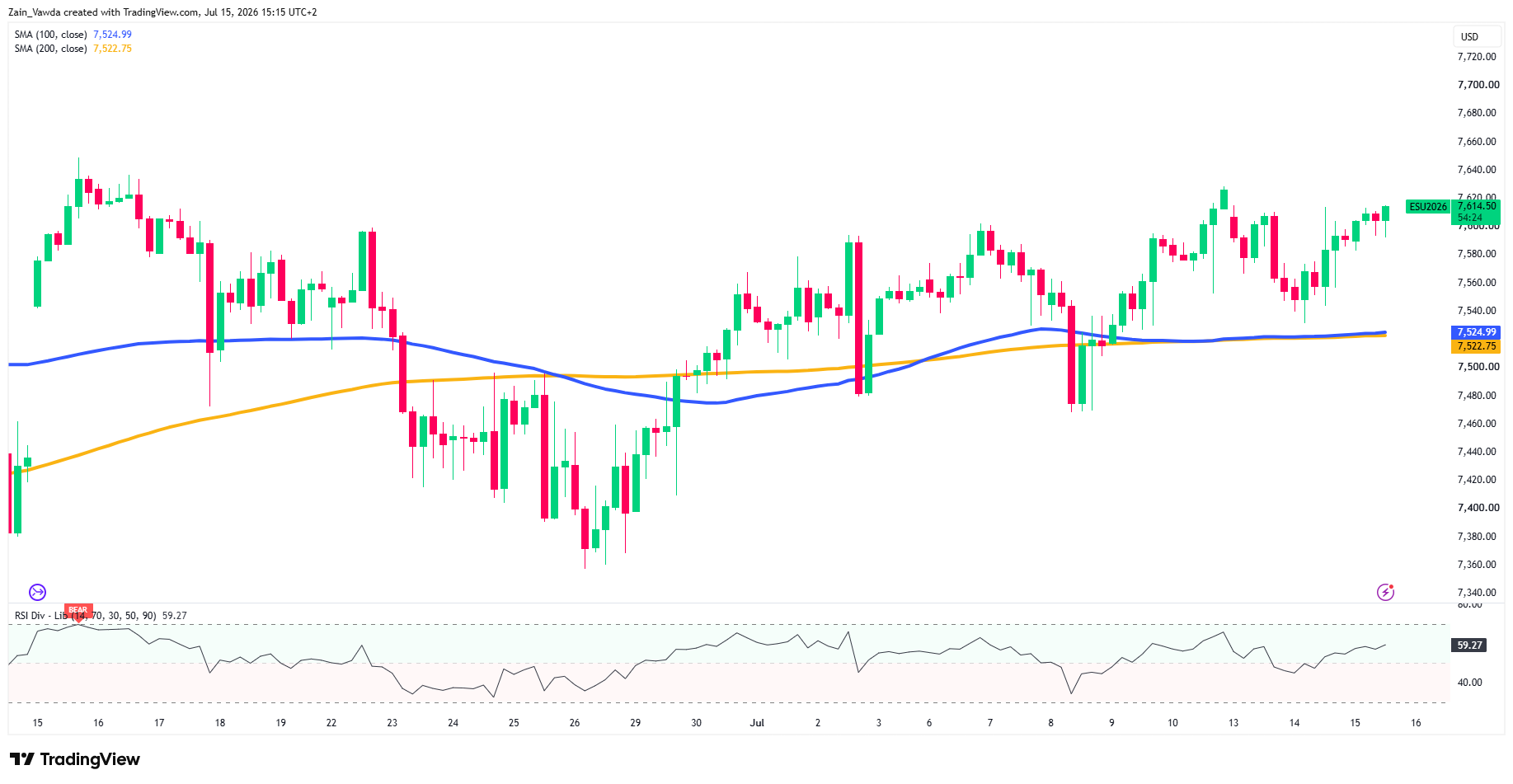
S&P futures has spent five weeks ranging between roughly 7,400 and 7,650 after the February–April drawdown and the violent recovery that followed.
S&P 500 Futures Four-Hour Chart, July 15, 2026
Source: TradingView
The contract reclaimed its rising 50-day average near 7,506 on last week's pullback, and Tuesday's move through 7,580/7,590 triggered a short-term buy signal into the retest of the June high.
Retests of unconfirmed highs fail more often than they succeed, the supply that capped the first attempt is usually still there, but this retest now arrives with half the referee's verdict delivered in the bulls' favour.
TSMC on Thursday completes it: a strong print with firm capex guidance quarantines the credit story to Oracle's balance sheet; a weak one generalises it.
In between sit today's Warsh's Senate testimony and the Beige Book — After a boost thanks to weak PPI data, two more chances for the rate path to take the wheel back from earnings.
Retail Trader Positioning
The current retail trader positioning data for the E-mini S&P 500 (ES) highlights a sharp divide between profitable and unprofitable accounts.
The top-performing "smart money" is currently net-short, while retail-leaning unprofitable accounts remain heavily long.
For more information on the latest retail trader positioning, take a look at the trade validator tool.


