
The driver behind the S&P 500's next leg higher has quietly changed. For most of 2026, the index climbed as investors paid up for the promise of artificial intelligence (AI). Multiples expanded, hyperscalers got the benefit of the doubt, and momentum did the rest.
That phase appears to be over. Two pieces of research published this week, one from Morgan Stanley's U.S. equity strategy team led by Michael Wilson, the other from LPL Research's Jeffrey Buchbinder, converge on the same diagnosis. The market has shifted from rewarding potential to demanding proof. Tonight's AMD earnings, dropping after the bell, are the next live test of exactly that thesis.
The Multiple Expansion Story Is Dead — Earnings Are Carrying the Index
Here's the number that undercuts the "stocks are frothy" narrative: LPL Research notes the S&P 500's forward P/E has actually fallen from 22.2 to 19.7 since the start of 2026, even as the index notched double-digit gains. That's not multiple expansion, but that's earnings growing faster than price. LPL puts second-quarter results on track for roughly 26% growth even after stripping out one-time markups from private stakes like SpaceX, with 86% of companies beating consensus, about 10 points above the long-run average.
Crucially, this isn't just an AI story anymore. LPL highlights that financials and healthcare are posting average earnings surprises of +14.7% and +11.9% respectively. This supports an earnings-broadening thesis beyond Big Tech, which raises the scope for further gains. Morgan Stanley's data backs this up from a different angle. Median stock earnings growth across the Russell 3000 has accelerated to 14%, and their earnings revisions breadth gauge is "bouncing materially" after a seasonal pause.
Free Cash Flow Is the New Battleground
If there's one metric that decides how stocks traded after earnings this cycle, LPL argues it wasn't revenue growth but free cash flow. That shift shows up plainly in how the market punished or rewarded the same basic story across four mega-cap reports the firm walks through:
- Alphabet's negative free cash flow paired with another spending hike sent shares reeling on monetization worries;
- Microsoft's fastest cloud growth in four years, delivered while holding capex guidance flat, proved it could afford its own buildout and got rewarded;
- Meta's free cash flow fell to its lowest level since 2022, forcing management onto the defensive about AI overinvestment;
- Amazon offset a capex increase with cloud and profitability numbers strong enough to win anyway.
LPL's conclusion: having the cash flow to back up AI spending — not just growth optics — has become the single biggest swing factor in post-earnings price action. "Markets have moved from promise to execution," as the firm puts it.
That shows up starkly at the index level. LPL calculates the S&P 500's earnings yield sits above 5%, reasonable by historical standards, while its free cash flow yield is just 3.5%, dragged down by the sheer scale of hyperscaler capital spending.
Tonight's Test Case: AMD
That framework gets its next real-world stress test tonight. AMD reports its second-quarter results after the close on Tuesday, with the earnings call scheduled at 5:00 p.m. ET. Management guided revenue to $11.2 billion (plus or minus $300 million), implying roughly 46% year-over-year growth; consensus sits slightly above that guide at around $11.3 billion, with EPS estimates clustering near $1.61, which would represent better than 235% year-over-year earnings growth. AMD has beaten Street estimates in each of the last four quarters, averaging a 6.5% surprise.
But per the LPL framework, the print itself may matter less than what comes after it. AMD stock closed at $484.64 heading into the report, down roughly 17% from its 52-week high, meaning the market is already looking past the second-half ramp toward the second-half ramp. Consensus estimates imply Q3 revenue near $12.5 billion and Q4 near $15.7 billion, an average of $14.1 billion per quarter in the back half versus roughly $10.8 billion in the first half. That's the real question investors are pricing: whether AMD's Helios AI-accelerator ramp, initial volume expected in Q3 with a bigger Q4 build, is credible on schedule — the same "prove the spending pays off" bar LPL flagged for the hyperscalers.
AMD's report also lands as a read-through for the broader chip trade Morgan Stanley has been tracking. The Philadelphia Semiconductor Index (SOX) has fallen more than 20% since late-June even after more than doubling over the trailing year, likely producing a near-term bounce, without necessarily restoring semis to sector leadership.
A strong AMD print with credible H2 guidance would fit Morgan Stanley's call for a tradable semis rally; a guidance disappointment, even on a Q2 beat, would reinforce their broader thesis that early-cycle, high-momentum sectors are losing their grip on leadership to steadier, higher-quality names.
Why AMD Could Move the Index, Not Just the Stock
AMD's weighting in the S&P 500 is modest next to the mega-cap hyperscalers, so a single-name move won't reprice the index on its own. But the report carries outsized signal value for two reasons that tie directly back to both firms' theses:
- It's a direct proxy for AI-capex durability. AMD sits downstream of the same hyperscaler spending Morgan Stanley and LPL both flag as the swing factor for market cash flows. Strong Helios demand signals validate that hyperscaler capex is translating into real orders, supportive of LPL's "more of the latter than the former" expectation that spending will eventually generate acceptable returns. Weak guidance would feed the opposite read: that capex is running ahead of demand.
- It arrives inside an already fragile momentum trade. With SOX down 20% since late-June, AMD's stock reaction, and any read-through to Nvidia, Broadcom, and the rest of the chip complex, could either validate Morgan Stanley's expected semis bounce or extend the sector's underperformance relative to the broader index, reinforcing the quality rotation both firms describe.
Given the S&P 500 is trading in a tight technical band, with support near 7,238, resistance near the record levels around 7,600-7,620, an AMD report that reinforces the AI-capex bull case could help build the mega-cap tech participation LPL says is required for a sustainable breakout. A disappointing one would add to the case that leadership needs to keep rotating away from high-momentum tech into the quality/value names Morgan Stanley favors.
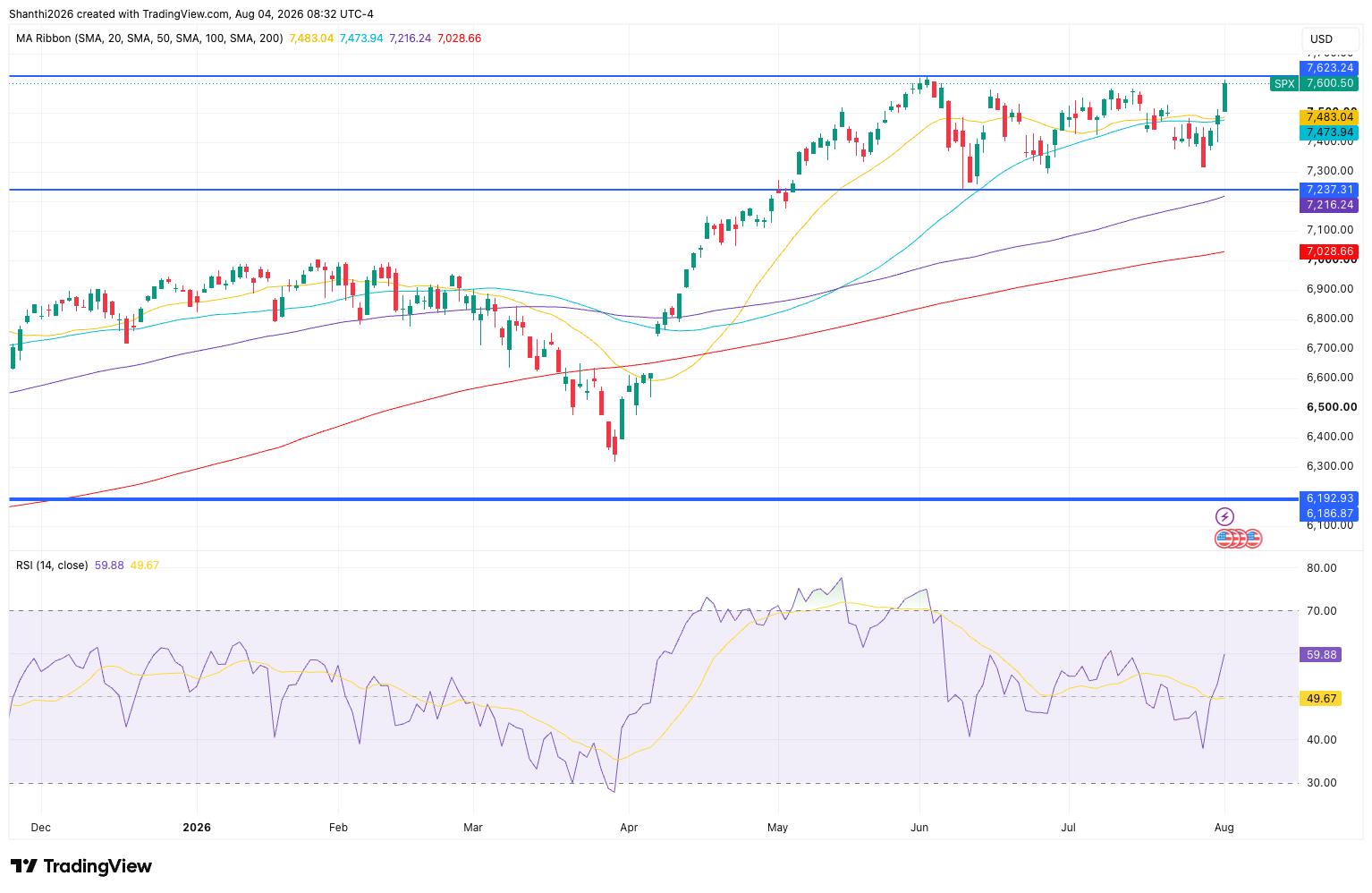
Source: TradingView
MarketFramework's Positioning Edge tool shows a mild bullish divergence in E-mini S&P 500 (ES) futures, a contract tied to the S&P 500 Index. Profitable traders are 33.3% long versus 30% among unprofitable traders, indicating the more successful side of retail is modestly more bullish on the index.
The Bottom Line
The bull case for the S&P 500 hasn't broken; it's gotten more selective, and more earnings-dependent than at any point earlier this year. Both Morgan Stanley (year-end target: 8,000) and LPL Research (fair value range: 7,650–7,750) agree the next leg higher rests on which companies can prove their AI spending generates real returns, not on paying more for the same story. AMD's report tonight, arriving in the middle of a fragile semiconductor trade and a market fixated on free cash flow over growth optics, is as clean a test of that thesis as investors will get this week.


