
Just when crude traders had begun to factor in a fading war risk premium and, by extension, a potential easing of inflationary pressures, Iran and the U.S. gave markets a stark reminder that volatility can flare up at any moment. The fragile nature of the interim peace deal agreed to by the two sides in mid-June had already been causing uneasiness among traders, and the latest flare-up went on to validate their worst fears.
Iran’s alleged attacks on commercial vessels passing through the Strait of Hormuz Monday night triggered responses from the U.S, making it a two-way violation. The X handle of the U.S. Central Command confirmed that the country has begun launching “a series of powerful strikes” against Iran.
https://x.com/CENTCOM/status/2074603238175998290
To add fuel to fire, U.S. President Trump said, while speaking ahead of the NATO Ankara Summit, that “It’s [deal] is over. I don't want to deal with them anymore. They're scum ... they're led by sick people and they're vicious, violent people.” He also stated that negotiations could continue”if they want” but saw it as a “waste of time.”
Bid Returns to Crude
From trading above $90 a barrel before the interim peace deal, oil swiftly reversed course as the geopolitical risk premium faded from the market. West Texas Intermediate (WTI) crude trended lower throughout the remainder of June, with the selling pressure extending into July. The benchmark fell to a low of $67.04 on July 2 as weak demand growth forecasts combined with a softer-than-expected Nonfarm Payrolls (NFP) report weighed on sentiment.
That trend reversed this week. Renewed tensions in the Middle East pushed WTI out of its recent trading range and back above the $70-a-barrel level on Tuesday. The rebound gathered further momentum on Wednesday after President Trump's comments raised doubts about the future of the U.S.-Iran interim peace framework.
In the European session, WTI crude climbed as high as $75.30, a gain of $4.86 or 6.9%, although the energy commodity has trimmed some gains since.
Is this a sustained-conflict repricing, or a contained flare-up?
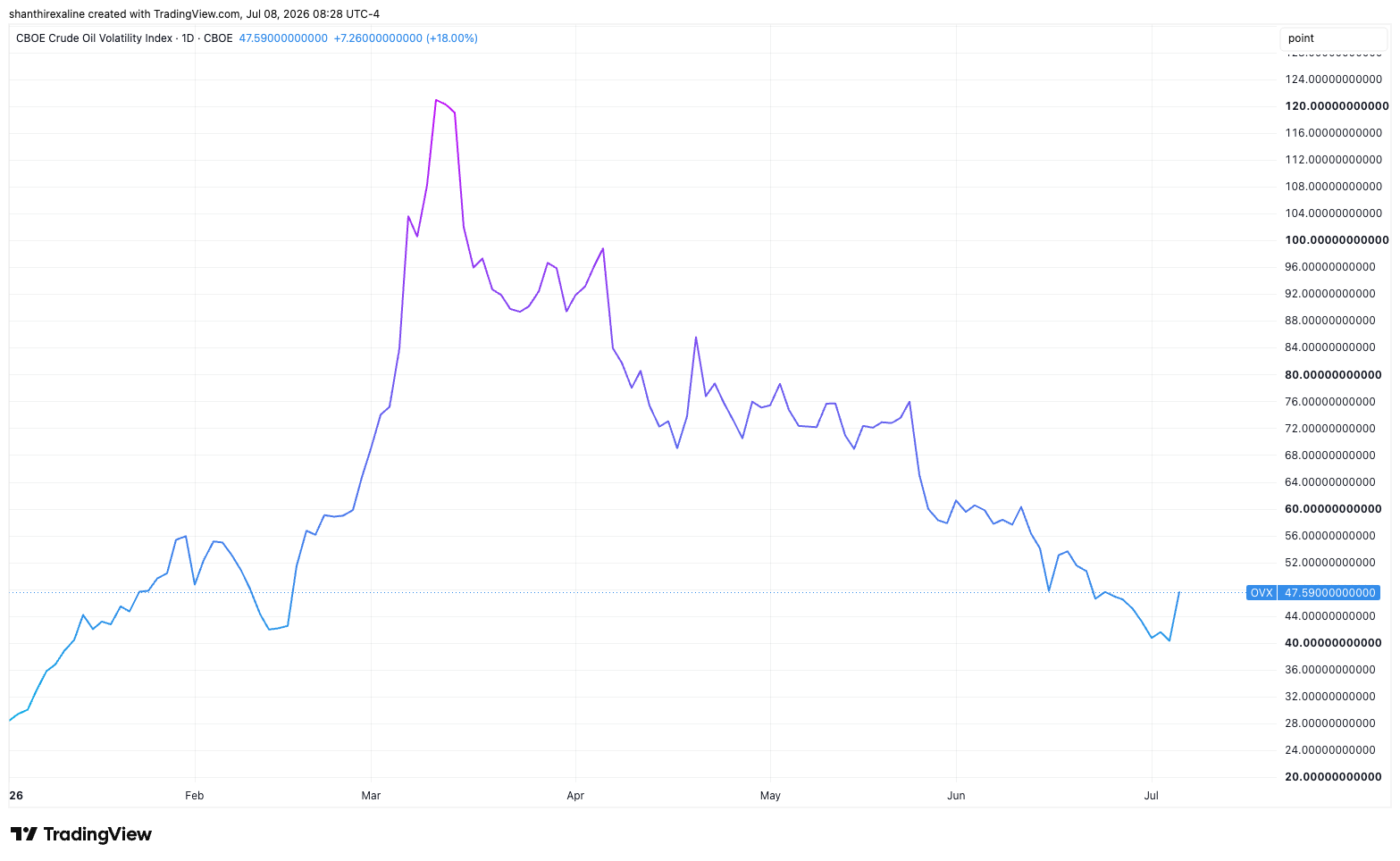
The recent rebound in the CBOE Crude Oil ETF Volatility Index (OVX) suggests traders are once again paying up for protection against sharp moves in crude oil. After falling steadily as the June U.S.-Iran accord reduced fears of supply disruptions, the oil fear gauge has begun to recover alongside crude prices, indicating that the market is rebuilding a geopolitical risk premium amid renewed tensions in the Strait of Hormuz.
Oil Fear Gauge Jumps on Renewed Iran Tensions
Source: TradingView
The OVX is signaling that traders are no longer treating Middle East tensions as a resolved issue; they are once again pricing in the possibility of significant volatility in crude markets over the next month.
It's a re-escalation of a war that's already been running since February 28, when U.S. and Israeli strikes killed Iran's supreme leader and triggered a near-total Hormuz shutdown that pushed oil to nearly $120 and held global inventories in freefall for months. Traders aren't pricing a new conflict but they are pricing whether the fragile reopening of the last several weeks reverses.
Positioning data over the last seven trading sessions indicates a pronounced long bias among retail traders, with 71% of winning trades in the CL contract originating from long positions., according to MarketFramework data.
Technical Picture Remains Cautious Despite Rebound
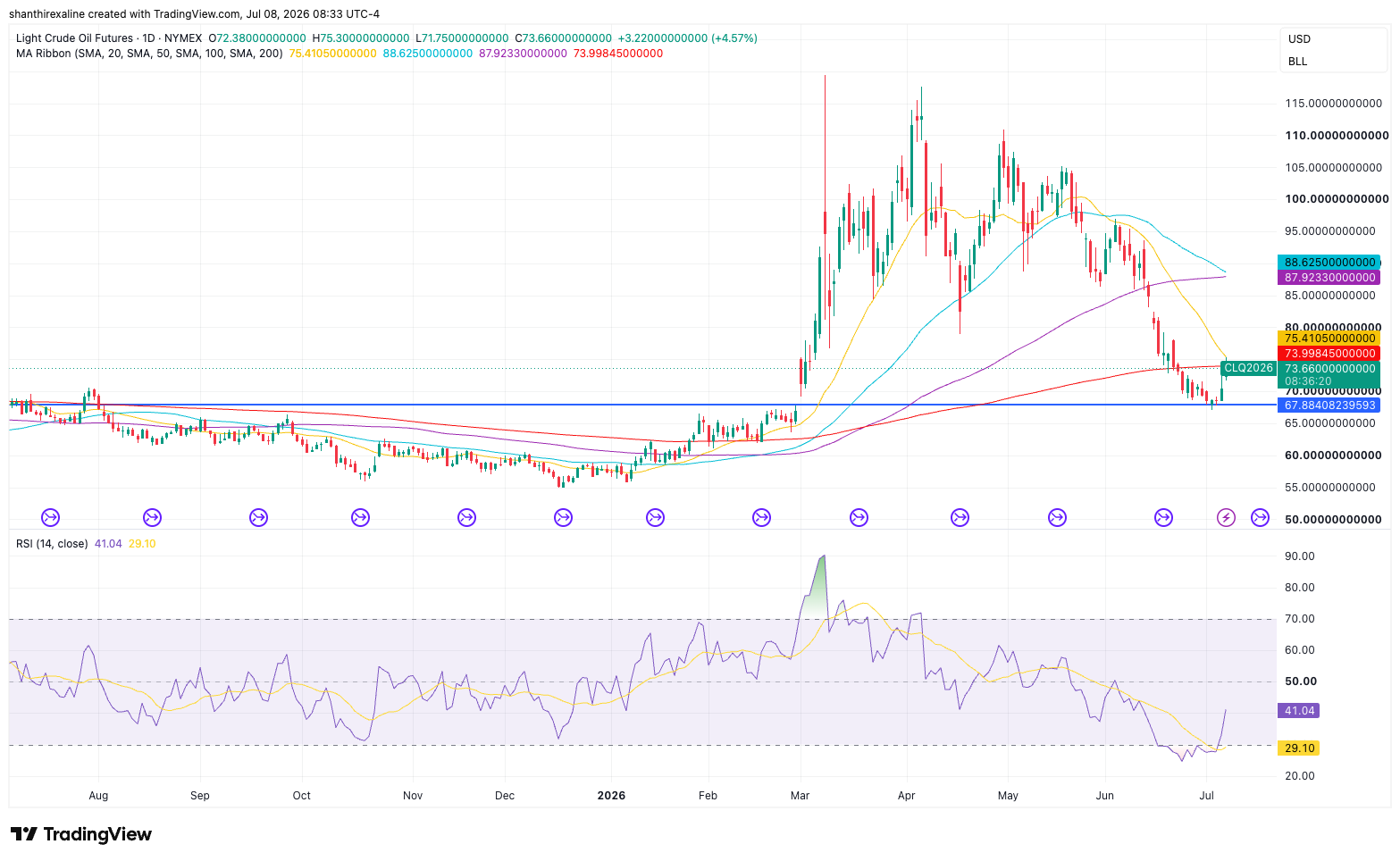
WTI has bounced sharply from the $67–68 support zone, a level that coincides with a key horizontal support area and sits just above the rising 200-day moving average. The defense of this zone suggests buyers are still willing to step in on geopolitical headlines.
However, despite the rebound above $73, price remains below the 20-day, 50-day, and 100-day moving averages, indicating that the medium-term trend is still tilted to the downside.
The sharp decline from the June highs created a series of lower highs and lower lows, and the current rally has yet to invalidate that bearish structure.
On the momentum front, the RSI has rebounded from near-oversold territory and is turning higher around the 40 level, suggesting downside momentum is fading and a relief rally may have room to extend.
Source: TradingView
The rebound above $70 suggests the market is rebuilding a geopolitical risk premium, but from a technical standpoint, WTI remains in a recovery phase rather than a confirmed uptrend. Bulls will need a sustained break above the $74–75 region to signal that the recent selloff has run its course. Until then, the move looks more like a relief rally within a broader corrective structure.
What Traders Should Watch Next
- AIS tanker-tracking data: The single most reliable signal will be whether transit volumes through Hormuz actually slow from June's recovering pace (Gulf exports above 10 million bpd) or collapse back toward the near-zero levels seen in March. Vortexa and Kpler flows, which use AIS signals and process them into usable intelligence, are the numbers that matter here/
- Iran's retaliation scale: A response confined to symbolic strikes or contained to shipping harassment reads very differently than an attempt to directly threaten Saudi, Emirati, or Kuwaiti export infrastructure. The latter would be the first genuine test of the market's assumption that this stays a "contained flare-up" rather than a supply-loss event.
- OPEC+'s next move: The group just approved a third straight monthly output increase on the assumption that normalization holds. Watch for any signal that the Gulf's largest producers no longer believe reopened flows are durable. That would be a far stronger confirmation of a supply story than any single day's price spike.
- CME FedWatch Tool: If oil's risk premium holds into next week, watch fed funds futures for whether traders start pricing that combination of renewed energy-driven inflation plus a Fed already leaning hawkish.


