The Latest: Strikes Resume at Dawn
The escalation cycle did not pause overnight. At 6 am ET on Wednesday, U.S. Central Command forces began launching a fresh wave of strikes against Iran, the command said in a post on X, adding that the strikes are designed to further degrade the military capabilities Iranian forces have used to attack commercial shipping in the Strait of Hormuz.
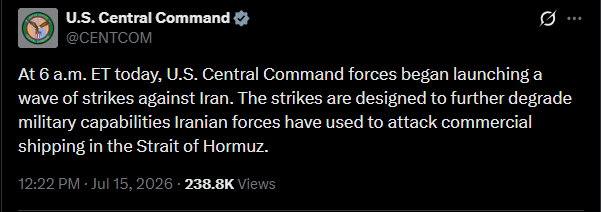
Source: X.com
It is the latest in a near-daily series of U.S. attacks since fighting reignited last week, and it landed hours after Washington reinstated its naval blockade of Iranian ports — keeping a firm bid under crude even as the most headline-grabbing element of Monday's announcement, the 20% cargo toll, was quietly buried.
The Pivot: Levy Out, Investment Deals In
Forty-eight hours after declaring the United States the “guardian” of the Strait of Hormuz and attaching a 20% reimbursement fee to every cargo transiting it, U.S. President Donald Trump has scrapped the toll.
In its place: a framework of “Trade and Investment Deals” that Gulf states will make into the United States, announced via Truth Social on Tuesday. The retreat followed near-universal pushback, the International Maritime Organization said there was no legal basis for the levy, and Hapag-Lloyd called fees on international waters fundamentally wrong.
Lipow Oil Associates had estimated the toll would have added roughly $16 per barrel to crude shipped through the strait.
For traders, the pivot removes a per-barrel cost mechanism but replaces it with something vaguer and arguably stickier: the strait's security is now bundled into bilateral investment negotiations.
The revenue channel has moved from the waterline to the negotiating table.
Why Oil Didn't Sell Off
Oil barely blinked at the toll's demise because the kinetic picture keeps deteriorating.
This morning's strikes follow a wave late Tuesday against dozens of military targets near the strait, missile and drone facilities, naval assets, coastal defences.
Centcom's commander said Iran had intentionally targeted civilians and hit seven commercial vessels inside a week; ADNOC confirmed two of its tankers were struck, with one mariner killed. Transit counts tell the story: 19 ships Friday, 24 Saturday, then just 10 by Monday per Kpler, against roughly 130 a day pre-war.
ING's commodities desk argues the returning blockade matters far more to the market than the toll ever did, and that the June memorandum of understanding is starting to look well and truly dead. The depleted strategic-reserve cushion, drawn down through March and April to blunt the first supply shock leaves the market more exposed to a rerun than it was in Q1.
This begs the question, if the status quo remains unchanged, could Oil rise beyond the Q1 highs when the war began around the $117,63 per barrel mark.
Technical Outlook - Oil Futures (CL1!)
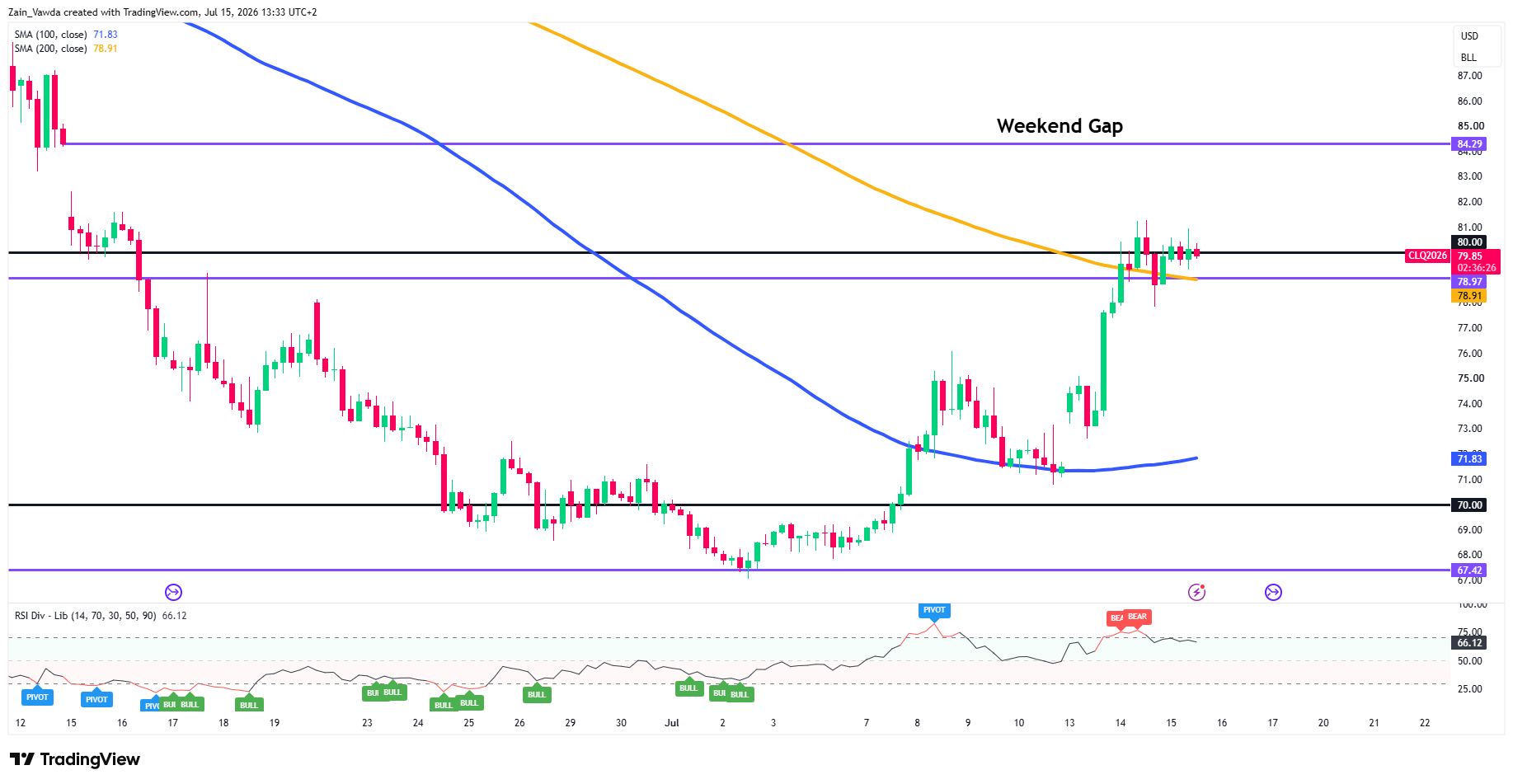
Oil is consolidating just around the psychological $80.00 handle after a sharp rally off the $71.00 base, with price now pinned between $80.00 and the 200-MA/support confluence at $78.91–$78.97.
Oil Futures Four-Hour Chart, July 15, 2026
Source: TradingView
The 100-MA ($71.83) is flattening and beginning to curl higher, signalling improving medium-term momentum.
However, the RSI (66.12) has printed back-to-back bearish divergence signals against the recent highs — a caution flag for longs at these levels.
A confirmed 4H close above $80.00 with some volume opens a run toward the weekend gap fill at $84.29. Failure at resistance and a break below $78.91 exposes $77.00, with deeper support at $75.00 and the $70.00 floor.


