
The Nasdaq 100 Index (NDX) is set to close the second quarter with impressive gains despite the bouts of volatility seen in June. The index has rallied more than 25% since the beginning of the quarter and was extending its advance on Tuesday, climbing over 1.5% in late-afternoon trading.
April proved to be the turning point, as equities rebounded sharply from the Iran conflict-driven selloff that rattled markets in March. Stocks then went parabolic through early June, with the NDX reaching an intraday record high of 30,762.20 on June 3. On a closing basis, the index had set an all-time high of 30,660.60 a session earlier. It has given back some of the gains since and sits at 30,260 currently.
How Major Indices Fared In April
The April rebound was fueled by easing geopolitical fears, resilient economic and earnings data, renewed enthusiasm for AI-driven growth, and a return of momentum-driven buying that quickly erased the March selloff. The rally also broadened to some extent. Small-caps participated in the rally, with the Russell 2,000 Index outperforming at various points. Cyclical stocks were also in favor.
However, leadership remained concentrated in AI-linked technology and semiconductor names, suggesting the rally's underlying engine continued to be the same mega-cap growth cohort that has driven the bull market for much of the past two years.
NDX Vs. RUT Vs DJI Vs SPX
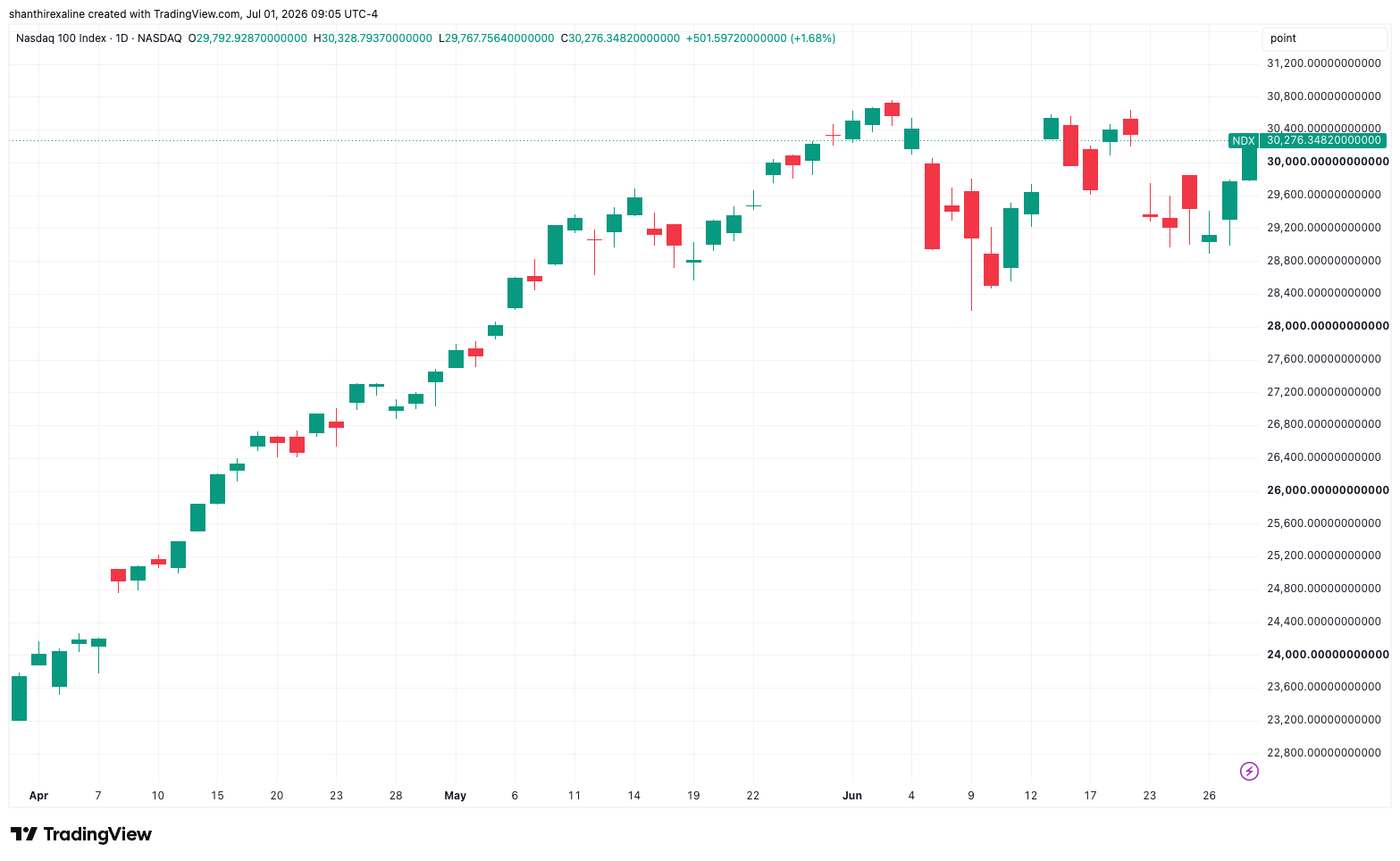
Source: TradingView
What Changed in June
Come June, the bullish sentiment that had powered the market's advance gradually gave way to skepticism. The first shock came from AI chipmaker Broadcom's fiscal 2026 third-quarter earnings report, which under ordinary circumstances would have been considered a strong print. Instead, investors focused on signs that challenged the narrative of insatiable and ever-accelerating AI demand, prompting concerns that expectations for the sector had become overly optimistic. As a result, bullish positioning in AI-linked names began to unwind.
The pressure was compounded by a hawkish shift in Federal Reserve policy under Chair Kevin Warsh. At his first policy meeting as central bank chief, Warsh delivered a decidedly hawkish message, surprising investors who had expected him to be more aligned with President Donald Trump's preference for lower interest rates. The removal of the easing bias from the policy statement, upward revisions to inflation forecasts, and a dot plot signaling the possibility of further tightening forced markets to reassess the trajectory of monetary policy, adding another headwind for richly valued growth stocks.
Nevertheless, the market proved remarkably resilient, avoiding an outright sell-off. Instead, June served as a period of consolidation, allowing investors to digest the substantial gains accumulated over the previous two months.Despite concerns over AI demand, a more hawkish Fed, and intermittent geopolitical tensions, buyers continued to step in on weakness, preventing a deeper pullback. The ability of equities to hold near record highs suggested that investor confidence in the broader earnings and economic outlook remained largely intact, even as expectations became more measured.
Technical Picture and Positioning
The E-mini Nasdaq (NQ) futures continue to trade above both their 50-day moving average (29,163) and 200-day moving average (26,176), with the 14-day relative strength index sitting between 50 and 60. This signals sustained but not extreme bullish momentum heading into the third quarter. Near-term resistance sits in the 30,500-30,975 zone, where the index has repeatedly stalled since the early-June peak; a decisive close above 30,975 would likely open the path back toward fresh record territory.
On the downside, the 29,200 area has acted as a key support zone, with the 29,163 region (the 50-day moving average) as the next line of defense should momentum fade further.
CFTC Commitments of Traders (COT) data for the week ended June 23 showed speculative traders holding a modest net short position of roughly 16,300 NQ contracts. Professional/leveraged accounts appear positioned closer to neutral heading into Q3, even as the index notches a historic quarterly gain. This is a divergence worth flagging, since it suggests the rally's biggest believers may be retail/momentum-driven rather than institutional, leaving room for either camp to be proven right as earnings season unfolds.
The key question heading into the third quarter is whether the forces that powered the post-war rebound remain intact. Can the major averages continue their relentless climb, or is the market due for a more meaningful correction?
Is the Bull Case Intact?
Unlike April and May, when multiple expansion and momentum fueled the advance, the market now needs earnings to justify elevated valuations.
Earnings Season Is the Immediate Catalyst
July and August will bring the Q2 earnings season, which is shaping up to be the most important test of the AI narrative since the rally began. According to FactSet, S&P 500 earnings growth will print around roughly 23% year-over-year, marking a second consecutive quarter of growth above 20% growth. It’s a no-brainer that energy will lead the earnings upside, thanks to the oil shock that kept prices elevated for much of the quarter.
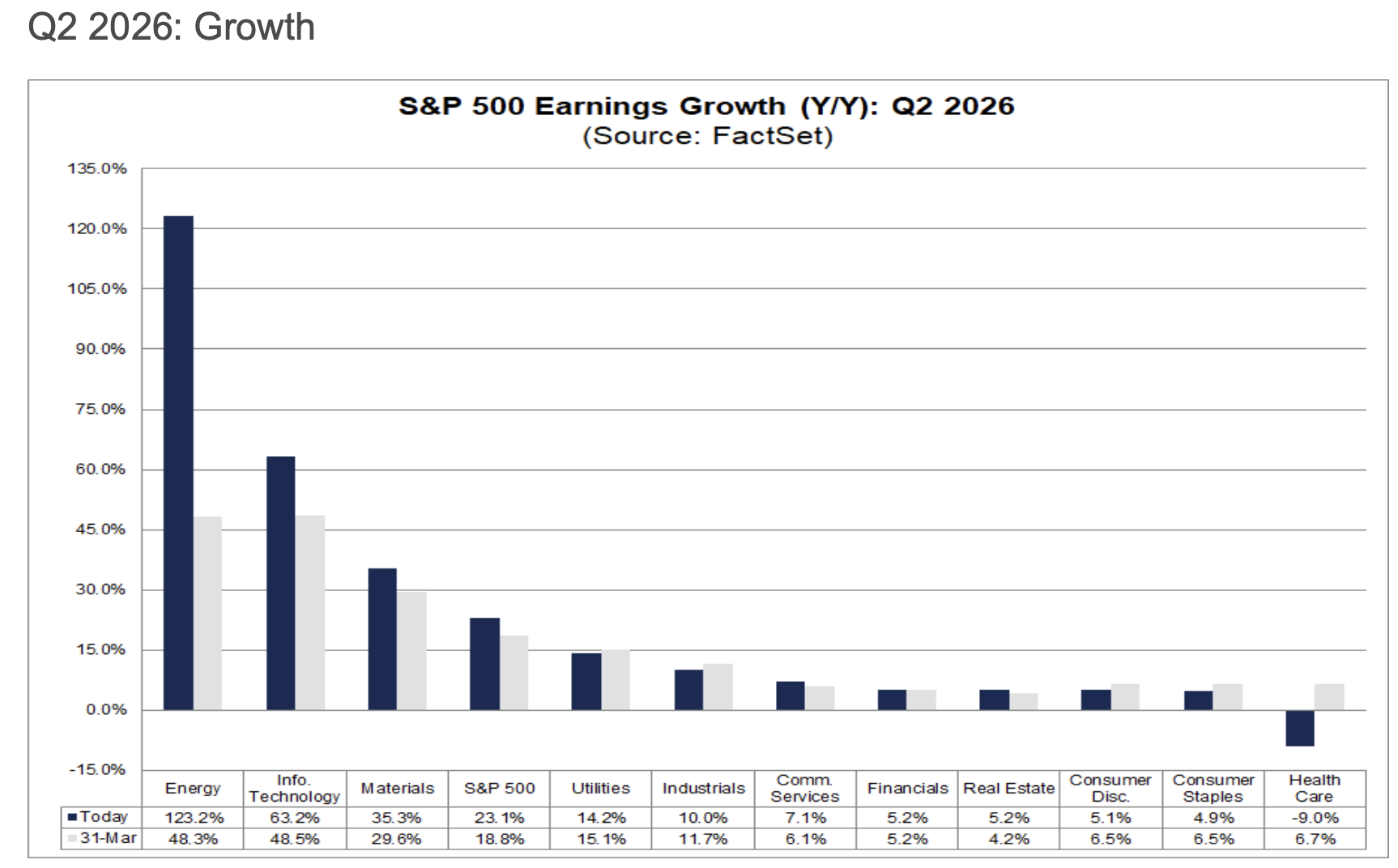
Source: FactSet
The challenge for AI-exposed stocks is that expectations remain extraordinarily high. After a rally that has added trillions of dollars in market capitalization across the AI ecosystem, investors are no longer rewarding companies merely for increasing AI spending. Instead, they want proof that the spending is generating incremental revenue and sustainable earnings growth. This raises the bar for companies across the value chain, from chipmakers and networking firms to cloud providers and software companies.
With valuations still elevated, even strong earnings reports may not be enough if management commentary suggests that AI demand growth is normalizing or that monetization is taking longer than expected.
OpenAI and Anthropic IPOs Could Reinvigorate the AI Trade
Another potential catalyst is the expected wave of marquee AI listings. Anthropic has already confidentially filed for an IPO, while OpenAI has also filed and could pursue a public debut as early as September.
These offerings could reinforce investor enthusiasm for AI and attract fresh capital into the sector. At the same time, they will serve as an important gauge of risk appetite and investors' willingness to support lofty valuations.
The Fed Remains the Biggest Macro Risk
The Federal Reserve has emerged as the primary source of uncertainty. Under Warsh, policymakers have adopted a distinctly hawkish tone, with projections pointing to the possibility of rate hikes later this year. Several major banks now expect a September rate increase. Bank of America has staked out the most hawkish call on the Street, now projecting three quarter-point hikes in 2026, one each in September, October, and December, that would lift the federal funds rate to 4.25%-4.50%.
As long as economic growth and labor-market data remain resilient, the market may tolerate a hawkish Fed. However, a sustained rise in Treasury yields would pose a challenge for richly valued growth and AI-related stocks.
The ingredients that powered the April rebound, namely AI optimism, strong earnings, and resilient economic growth. have not disappeared. However, the market is entering a phase in which expectations are considerably higher. For the Nasdaq 100 to extend its gains in Q3, corporate earnings will likely need to validate the enormous AI spending underway, while the Fed must avoid becoming sufficiently hawkish to undermine equity valuations. If those conditions are met, the rally could broaden further; if not, investors should expect a more volatile and selective market environment.


