
Seagate delivered exactly the kind of print the artificial intelligence (AI)-storage trade wanted to see. Nasdaq futures didn't care. Wednesday's session is a reminder that in a market this jumpy, one good earnings report isn't enough to override the macro overhang — and that the real test for tech sentiment is still hours away.
A Beat That Couldn't Hold the Tape
Seagate's fiscal fourth-quarter results were about as clean as they come. Revenue of $3.63 billion beat estimates by 3.6%, adjusted EPS of $5.71 topped consensus by more than 12%, and next-quarter guidance of $4.1 billion came in 9% above what the Street was modeling. Q4 non-GAAP gross margin expanded to 52.7% from 37.9%, free cash flow hit a record $3.1 billion for the fiscal year, and CEO Dave Mosley pointed to "robust cloud data center demand" as the engine behind it all.
The stock's own reaction told the story of a market still finding its footing. STX shares, which tumbled more than 8% in the regular session, reversed to close up over 7% after hours as investors digested the beat.
Yet Nasdaq futures barely register the win. NQ has stayed under pressure Wednesday, with stock futures ticking lower as oil prices rose after the U.S. intercepted an Iranian attack on American forces in the region, a reminder that single-stock catalysts, however strong, are currently getting steamrolled by macro headlines.
Multiple Catalysts Collide in Single Session
There's a third variable layered on top of chips and oil: the Federal Reserve itself. The Fed announces its interest rate decision on Wednesday, at 2:00 p.m. ET, following a two-day meeting, with no updated economic projections or dot plot accompanying this particular decision.
The FOMC has held the federal funds rate at 3.50% to 3.75% through four consecutive 2026 meetings, citing inflation that remains above the 2% target, and consensus heading into this meeting points to another hold at that same range. That combination — a same-day rate decision, a press conference, and two mega-cap earnings reports — means NQ traders are effectively navigating three separate volatility events within a few hours of each other, which helps explain why even a strong outlier like Seagate isn't moving the tape on its own.
Chips and Crude Are Setting the Agenda, Not Earnings
The drag on NQ has less to do with any one report and more to do with what's happening around it. The chip rout that has dogged the index for more than a week deepened again overnight, with South Korea's Kospi and Taiwan's Taiex both sliding sharply and dragging U.S.-listed semiconductor names lower into the open. The catalyst was an earnings miss from South Korean memory-chip giant SK Hynix. To be clear, the results were far from weak—the company posted record profit. The problem was that earnings failed to clear the market's lofty expectations, reinforcing concerns that even strong AI-driven chip demand may no longer be enough to justify elevated valuations.
At the same time, oil's renewed spike on fresh Middle East fighting has reintroduced an inflation-and-rate-risk overlay that tends to weigh disproportionately on richly valued growth names — exactly the cohort NQ is stacked with.
In other words, Seagate's beat is a single data point in a tape currently being driven by two much bigger forces: semiconductor sentiment and geopolitical risk. Until those settle, good earnings from individual names may keep getting absorbed rather than rewarded.
Why Tonight Matters More Than This Morning
That's what makes Microsoft and Meta's after-the-bell reports the real inflection point for NQ, not Seagate's. Both are reporting Wednesday, and options markets are pricing unusually large moves for both names. Microsoft's options imply a swing of roughly 6.5%–7.2% in either direction, well above its historical average and enough to represent close to $190 billion of market value in play. Meta's options imply an even larger swing, around 7%–7.8%, also above its own historical norm.
Analysts expect Microsoft to post adjusted EPS around $4.21–$4.24, up double digits year-over-year, on revenue near $87.6 billion, with Azure growth and AI-adoption metrics as the numbers investors will parse hardest. Meta is expected to report revenue near $60.3 billion, roughly flat-to-up on an adjusted EPS basis, with the market's attention squarely on whether AI capital spending is starting to show up as margin-expanding rather than cash-burning.
The size of those implied moves matters for NQ specifically: Microsoft and Meta are both index heavyweights, and a swing in the high single digits from either — let alone both — would move the futures contract far more than any overnight session's macro drift.
For now, the futures market is telling a straightforward story: individual beats aren't yet enough to offset the chip-and-oil overhang. Whether that changes depends less on what already happened at Seagate and more on what Microsoft and Meta say about AI spending, cloud growth, and margins once the bell rings.
NQ Breaks Key Support as Bears Tighten Their Grip
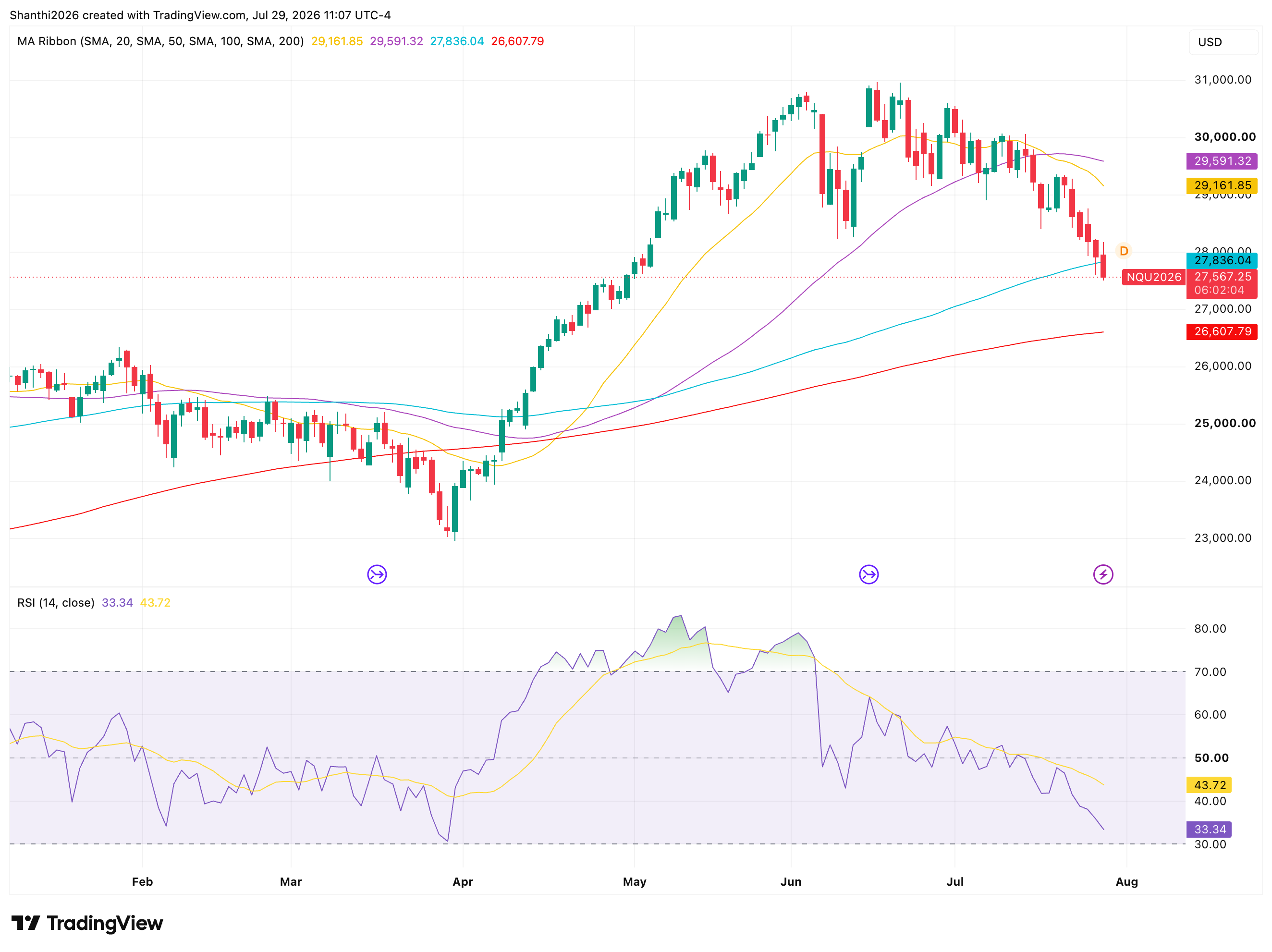
The technical picture for Nasdaq-100 (NQ) futures has deteriorated after the contract broke below its 100-day simple moving average (27,836), a level that had provided support throughout June and July. The decline also reinforces a pattern of lower highs and lower lows since the June peak near 30,700, suggesting the uptrend has given way to a developing bearish trend. The recent price action resembles a potential head-and-shoulders top, with the neckline around 27,800–28,000 now under pressure, although the pattern is not yet fully confirmed. Meanwhile, the contract remains below both the 20-day (29,162) and 50-day (29,591) moving averages, signalling that sellers retain control of the short-term trend.
Source: TradingView
Momentum indicators also favour the bears, with the 14-day RSI falling to around 33, placing the market close to oversold territory. While that raises the possibility of a short-covering bounce—particularly after earnings from Microsoft and Meta—it does not, by itself, signal a durable bottom. Unless NQ quickly reclaims the 100-day moving average, rallies are likely to face selling pressure, with 27,000 emerging as the next key downside target, followed by the 200-day moving average near 26,608.
MarketFramework Positioning Edge tool shows retail sentiment remains modestly tilted toward long positions. However, trade outcomes paint a different picture: only 35.3% of profitable trades were long bets, while 63.3% of losing trades were short positions.
The fact that nearly two-thirds of losing trades were shorts indicates that bearish bets have struggled, implying the broader trend has continued to favour the upside even as retail positioning remained only modestly bullish. This points to underlying resilience in the market rather than a strong contrarian signal.
The Bigger Picture
For now, the futures market is telling a straightforward story: individual beats aren't yet enough to offset the chip-and-oil overhang. Whether that changes depends less on what already happened at Seagate and more on what Microsoft and Meta say about AI spending, cloud growth, and margins once the bell rings.