Story updated to include quotes in the second paragraph
South Korea's Kospi plunged nearly 11% as memory chipmakers Samsung, SK Hynix, and Kioxia were hammered in a single session. That panic didn't stay in Seoul. U.S. semiconductor names, including AMD and Intel, are indicated lower in sympathy, dragged down by a story that, on closer look, isn't really theirs to tell.
The sell-off in the chip space has continued unabated on Wall Street, with the Philadelphia Semiconductor Index down near 5%. This has dragged the tech-heavy Nasdaq 100 down about 1% even as the Dow Jones Industrial Average climbed over 1%.
What Actually Happened in Asia
The Korea Composite Stock Price Index plummeted 10.84%, briefly falling more than 11% intraday and breaching the 6,000-point level. Samsung dropped over 13%, SK Hynix fell more than 14%, and Kioxia plunged over 18%. The Korea Exchange triggered a market-wide circuit breaker, halting trading for 20 minutes, the eighth such halt this year.
The cause wasn't a demand shock. It was a supply-and-competition problem. Fears around Chinese competitor ChangXin Memory Technologies, paired with broader skepticism toward artificial intelligence (AI) capital-return cycles, set in motion an across-the-board sell-off. Adding to the overhang, a report emerged that China has begun manufacturing domestically developed immersion deep-ultraviolet lithography machines, a technology long dominated by Dutch equipment maker ASML, raising longer-term questions about China's ability to close the gap in advanced chipmaking.
This is a memory-chip story, rooted in Chinese competitive pressure on DRAM, NAND, and related manufacturing capacity.
A Sector Priced for Perfection
Memory chipmakers had run up hard before this week's selloff, and that's a big part of why the reaction was so violent. Samsung, SK Hynix, and Kioxia had all re-rated sharply higher over the past year on the back of surging demand for high-bandwidth memory (HBM) tied to AI servers, alongside tightening DRAM and NAND supply that gave the sector real pricing power for the first time in years. That combination — AI-driven demand plus disciplined supply has pushed memory valuations well above their historical norms, with the market effectively underwriting years of continued pricing strength.
Memory Chipmaker's Heady Valuation
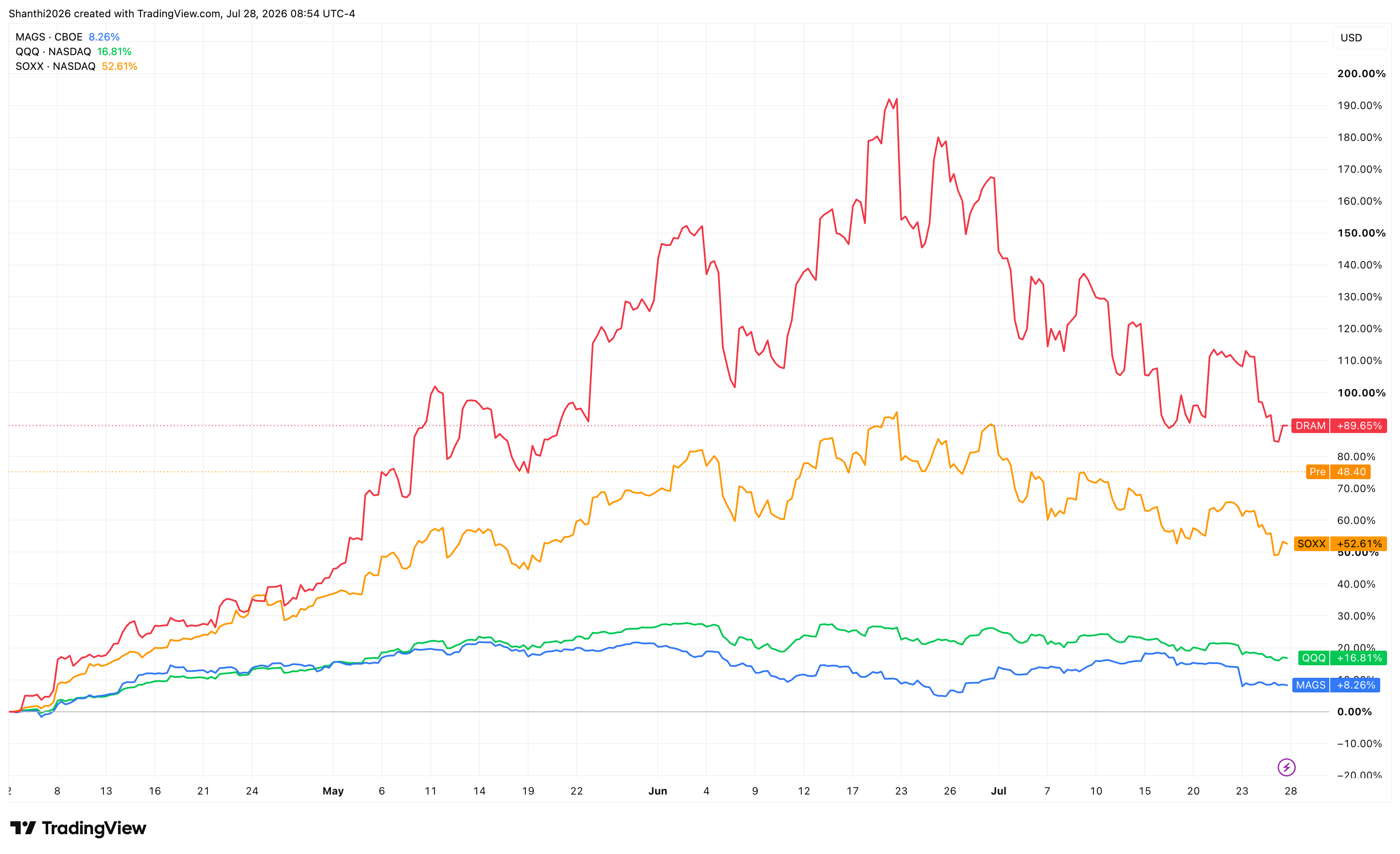
Source: TradingView
That kind of setup leaves little room for a competitive shock.
Why AMD and Intel Are Getting Pulled In
AMD and Intel aren't primarily memory businesses. Their exposure to the Samsung/SK Hynix/Kioxia story is indirect through the same semiconductor industry, overlapping supply chains, and a market that tends to sell first and sort out the details later. When a sector-defining name like Samsung drops double digits, sympathy selling across the broader chip complex is a near-automatic reflex, regardless of whether the underlying businesses share the same risk.
That's the contagion. It's a correlation trade, not necessarily a fundamentals trade.
Seagate Earnings: A Direct Read on the Memory Story
Unlike AMD and Intel, Seagate is a name where this week's earnings, due after Tuesday's close, actually speak to the same story shaking Asia. Seagate's storage business sits closer to the memory and NAND complex than to logic/processor chips, making its results a more relevant near-term test of whether the ChangXin competitive threat and AI-storage demand assumptions are showing up in real numbers, rather than just sentiment.
If Seagate's guidance holds up despite the Asia rout, that's a data point suggesting the panic is concentrated in Korean supply dynamics rather than a broader storage-demand problem. Soft guidance or cautious commentary on pricing, by contrast, would lend some credibility to the fear spreading out of Seoul.
The Case That the Fear Is Overdone
A few reasons this sell-off may not fully apply to names like AMD and Intel:
Different exposure, different risk. Chinese memory competition and domestic lithography ambitions is a multi-year structural risk to memory pricing and equipment moats. It doesn't directly touch AMD's CPU/GPU roadmap or Intel's foundry and processor business in the same way.
Demand-side proof is coming this week, not from Seoul. The real test of whether AI-related chip demand is intact comes from hyperscaler earnings. Microsoft, Alphabet, Amazon, and Meta all report in the days ahead, offering a direct read on capex plans and AI monetization. That's a far more relevant signal for logic/processor names than a memory-sector panic in Korea.
Volatility hasn't caught up to the headlines. Despite an 11% single-day move and an actual trading halt in Seoul, U.S. volatility (the VIX) barely moved (up merely 0.70%). That gap suggests the U.S. market hasn’t fully priced in either the severity of the Asia move or a genuine reassessment of AI-chip fundamentals. It looks more like reflexive sympathy selling than a repricing of AMD's or Intel's actual businesses.
The Case That It's Not Overdone
To be fair to the other side: broad-based skepticism toward AI capital-return cycles doesn't respect neat category lines. If the market's real concern is that AI infrastructure spending across the board has outrun realistic returns, that skepticism applies to logic and processor names too, not just memory. Nvidia, Broadcom, and Marvell were also indicated lower in the same sympathy move — and if hyperscaler earnings this week show decelerating AI capex or disappointing returns, the "contagion" framing collapses, because the fear turns out to have been justified for the whole sector, not just memory.
What to Watch Next
- Seagate's earnings after Tuesday's close: It is the most direct near-term read on whether the memory/storage demand story is cracking or holding.
- Hyperscaler earnings this week: which gives the actual test of AI-chip demand, independent of what's happening in Asian memory markets.
- Whether AMD, Intel, Nvidia, and Broadcom stabilize while Samsung, SK Hynix, and Kioxia continue to slide: A split would support the contagion thesis; a shared decline would undercut it.
- Wednesday's FOMC decision: The key Main Street event of the week landis right behind the earnings cluster, with markets already pricing a reduced, but higher probability that the Fed holds this week.
The panic in Seoul is real, and it's rooted in a specific, identifiable threat — Chinese memory competition and lithography ambitions. Whether that fear belongs on AMD's and Intel's doorstep is a separate question, and Seagate's earnings after the close, and this week's hyperscaler earnings, not this morning's Kospi print, will be the ones to answer it.