
U.S. stock-index futures barely reacted after President Donald Trump announced a three-day pause on planned 50% tariffs targeting roughly $20 billion of Canadian imports, a move that would normally be expected to spark a relief rally. Instead, traders largely looked through the headline, treating it as a temporary reprieve rather than a definitive breakthrough.
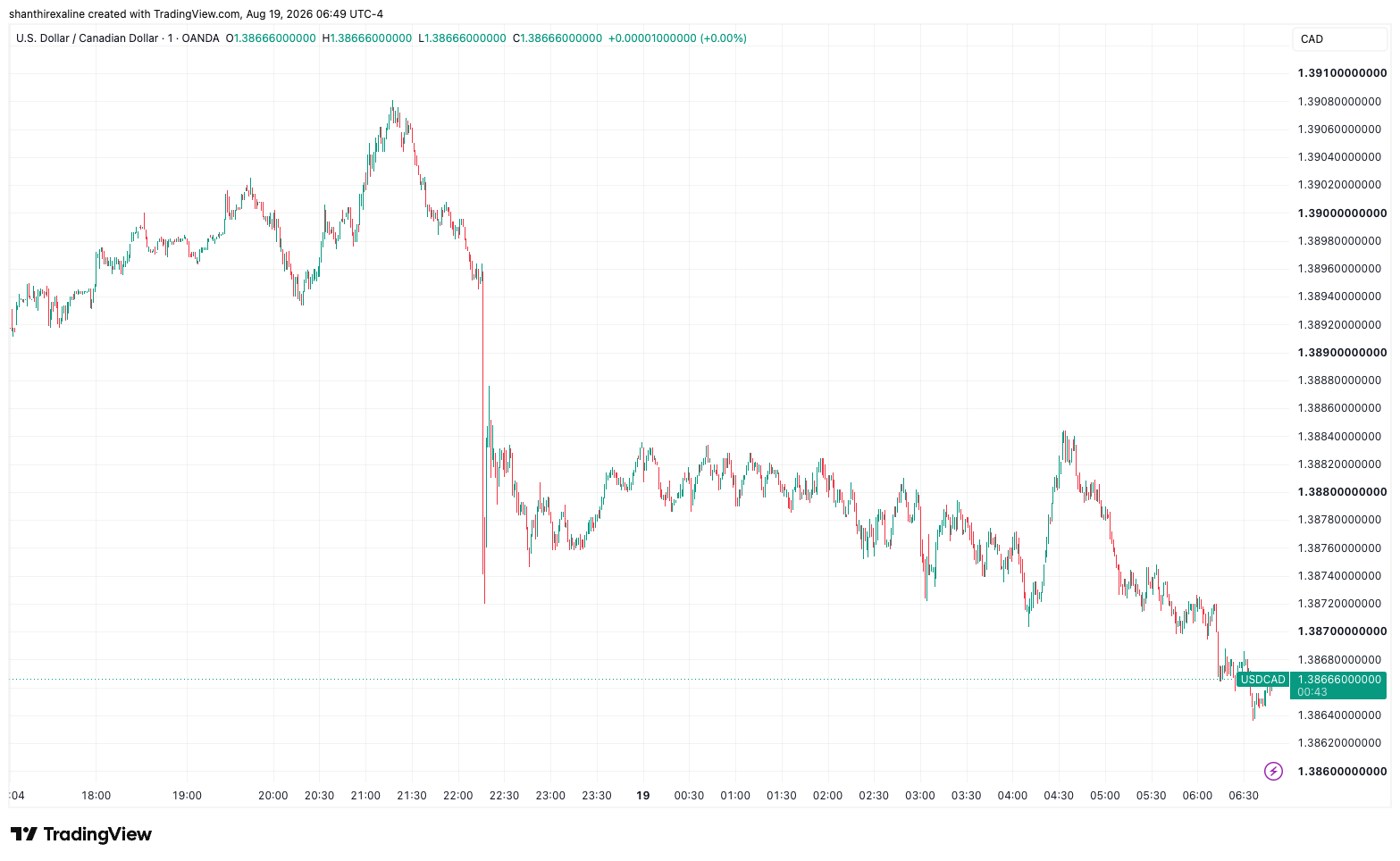
U.S. equity futures showed little enthusiasm after the announcement, while Canadian assets posted only modest gains. The Canadian dollar, or loonie, edged higher but failed to stage a decisive breakout, and investors largely treated the development as a temporary reprieve rather than a genuine resolution of the trade dispute. are finalized. The pause helped remove the worst-case scenario but stopped short of delivering the certainty needed for a stronger currency rally, and also struggled to displace the market's broader macro narrative.
USD/CAD Pair Subdued
Source: TradingView
The muted response reflects a market that had already anticipated some form of last-minute compromise. Negotiations between Washington and Ottawa had intensified in the days leading up to the tariff deadline, with both sides signaling a desire to avoid a damaging escalation in trade tensions. By the time the pause was announced, investors had largely priced in the likelihood that the tariffs would be delayed or softened.
A Pause, Not a Deal
The key reason futures barely moved is that there is still no finalized agreement. Trump described the arrangement as a preliminary deal, while Canadian Prime Minister Mark Carney stressed that significant work remains before a comprehensive trade pact can be completed.
https://x.com/MarkJCarney/status/2089917753620578567
The tariff suspension lasts only three days and depends on the successful completion of negotiations. For investors, that means uncertainty has been postponed rather than eliminated. Markets generally reward clarity, and the current announcement offers little of it. A signed agreement would provide a clearer basis for revising growth, inflation, and corporate earnings expectations. A temporary pause does not.
Limited Economic Impact
Another reason for the lack of excitement is the relatively narrow scope of the threatened tariffs. The proposed measures cover about $20 billion of Canadian exports to the U.S., representing only a small portion (about 5% of the total value of Canadian imports to the U.S.) of the overall trade relationship between the two countries. Analysts had already viewed the direct economic impact as manageable, reducing the urgency of the news for equity investors.
Moreover, much of the broader U.S.-Canada trade flow remains governed by United States Mexico Canada Agreement (USMCA) provisions and existing exemptions, limiting the immediate macroeconomic fallout from the proposed duties.
Bigger Drivers Still Dominate
The tariff pause also arrived at a time when investors remained more focused on interest rates, economic growth, inflation trends, and corporate earnings than on a narrowly targeted trade dispute. While trade headlines can generate short-term volatility, they have struggled to displace the market's primary focus on the outlook for monetary policy and the economy.
That helps explain why equity futures treated the announcement as a secondary development rather than a game-changing catalyst.
The Market's Message
While tariffs are generally viewed as a headwind for equities, their impact varies significantly across major U.S. index futures.
The E-mini Dow (YM) is typically the most sensitive to tariff headlines because the Dow Jones Industrial Average has a larger concentration of industrial, manufacturing, transportation, and multinational companies whose earnings are directly tied to global trade flows and imported inputs. Tariffs can raise costs, disrupt supply chains, and invite retaliatory measures, making Dow components particularly vulnerable. Studies of tariff announcements have found some of the largest negative market reactions in industrial and materials sectors.
The E-mini S&P 500 (ES) sits in the middle. The benchmark index contains both tariff-sensitive sectors such as industrials, materials, and consumer goods, as well as more insulated areas like communication services and software. As a result, tariff news tends to influence ES through its broader implications for economic growth, inflation, and corporate profits rather than through direct sector exposure alone.
The E-mini Nasdaq-100 (NQ) often reacts differently. Although some technology hardware companies have extensive global supply chains, a large share of the Nasdaq's market capitalization comes from software, digital services, internet platforms, and other businesses that are less directly exposed to tariffs on physical goods. Research from Nasdaq shows the index's heavy weighting toward services-oriented technology companies has made it relatively more resilient to tariff-related cost pressures than broader market benchmarks.
In the case of the Canada tariff pause, the muted response in YM futures suggests traders never believed the threatened tariffs would significantly impair North American industrial activity. Meanwhile, the limited moves in ES and NQ indicate investors remained focused on bigger drivers such as Federal Reserve policy, economic growth, and earnings rather than a temporary pause affecting a relatively small slice of U.S.-Canada trade.
A strong relief rally would likely have seen YM outperform ES and NQ, reflecting reduced risks for manufacturers, transport firms, and other trade-sensitive sectors. The absence of such a move suggests markets viewed the announcement as a negotiating extension rather than a meaningful shift in the economic outlook.


