
For much of the past three years, traders have learned to watch not just the yen, but the words coming out of Tokyo. When USD/JPY rose too quickly, Japanese officials typically responded with a familiar playbook: verbal intervention, warnings against "excessive" currency moves, and reminders that authorities were monitoring markets with a sense of urgency.
This time, something is different.
Despite USD/JPY trading comfortably above levels that previously triggered official concern, Japanese policymakers have remained remarkably quiet. The forex market was bracing for an intervention during the Marine Day public holiday due Monday but it was not to be.
That silence may be sending a more important signal than any headline-grabbing intervention threat.
Why the lack of warnings matters
Japan's Ministry of Finance and the Bank of Japan (BoJ) are generally less concerned about the absolute level of the yen than the speed and disorderliness of its decline. Historically, verbal intervention has emerged when currency moves threatened to become destabilizing for businesses and financial markets.
Today's environment looks different. The yen's weakness has been relatively orderly, driven largely by fundamentals rather than speculative attacks. The Federal Reserve continues to maintain significantly higher interest rates than the BoJ, preserving a yield gap that encourages investors to hold dollars over yen. As long as that differential remains wide, upward pressure on USD/JPY is difficult to reverse.
In that context, Japanese officials may see little benefit in fighting a move that is largely justified by monetary policy divergence.
A shift in policy priorities
Tokyo's restraint also reflects changing economic realities. After decades of battling deflation, Japan has finally achieved a more durable inflation backdrop. A weaker yen raises import costs, but it also supports exporters, boosts overseas earnings when repatriated, and can contribute to inflation staying closer to the Bank of Japan's target.
That does not mean authorities welcome unlimited yen depreciation. Rather, it suggests their tolerance threshold may be higher than investors assume.
The absence of verbal intervention implies policymakers are not yet viewing current currency levels as problematic enough to warrant action.
What traders should watch
The key risk for USD/JPY bulls is not necessarily the exchange rate itself but the pace of future moves.
If the pair continues to climb gradually, officials may remain on the sidelines. However, a sharp, speculative surge could quickly revive intervention rhetoric, even if the underlying fundamentals remain unchanged.
For now, traders may be focusing too much on where USD/JPY is trading and not enough on how Japanese policymakers are reacting. The pair has further leeway to run, according to ING forex strategists. “It would not be a surprise to see USD/JPY briefly break above 162.75/85 over coming sessions on the assumption that the Bank of Japan is a no-show on intervention, “ they said.
The BoJ’s next rate-setting meeting has been scheduled for July 30-31. Policymakers would keep the uncollateralized overnight rate unchanged at a 31-year high of 1% at the meeting, local news reports, citing sources, said. BoJ is also expected to nudge up their economic growth forecast, citing rising demand tied to artificial intelligence (AI).
USD/JPY Rally Faces a Key Test
From a chart perspective, USD/JPY remains in a well-defined uptrend, supported by a series of higher highs and higher lows. The pair has successfully reclaimed major moving averages, indicating that buyers remain in control of the broader trend.
The most important technical feature is the lack of bearish divergence between price and momentum. Unlike previous yen selloffs that showed signs of exhaustion as the pair approached intervention-sensitive levels, the current advance has been accompanied by steady momentum rather than a speculative blow-off move.
Resistance is less about a precise technical level and more about market psychology. Traders are watching whether USD/JPY can sustain gains above recent highs without triggering a surge in volatility. A clean breakout would likely invite momentum and trend-following funds back into the trade, while a rejection could encourage profit-taking and a short-term pullback.
On the downside, the first signal of trend fatigue would be a break below the most recent swing low near 161, which would interrupt the sequence of higher lows that has defined the rally. Until that occurs, pullbacks are likely to be viewed as corrections within an uptrend rather than the start of a broader reversal.
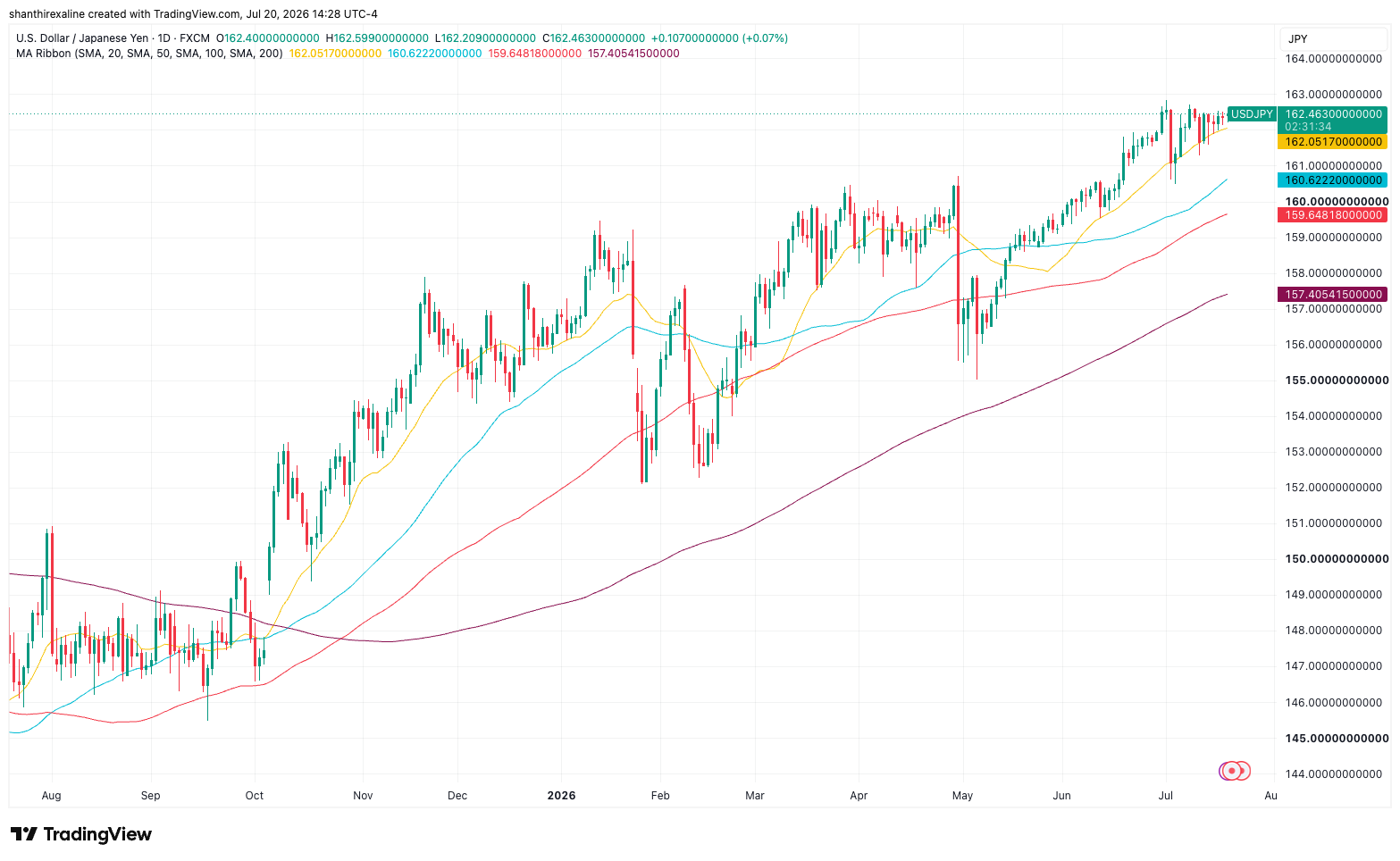
Source: TradingView
The absence of official intervention rhetoric is acting as a technical tailwind. Markets tend to respect trends until a catalyst emerges to challenge them, and neither the chart nor policymakers are currently providing that catalyst.
Check out MarketFramework's Positioning Edge toolto see where retail traders are stacking their USD/JPY bets
The bottom line
Markets often focus on what policymakers say. In the case of USD/JPY, what they are not saying may matter more. The absence of warning shots from Tokyo suggests Japanese authorities are currently comfortable allowing market forces to dictate the yen's direction. Until that changes, the silence itself may be the strongest signal supporting the dollar's advance against the yen.