The U.S. Dollar Index (DXY) has spent the past several sessions in a rangebound manner. With the Federal Reserve's rate decision due at 2 p.m. ET, DXY's flatline near 101.40 looks less like calm and more like coiled tension, as traders wait for Chair Kevin Warsh to hand the market its next directional cue.
A Range That Refuses to Break
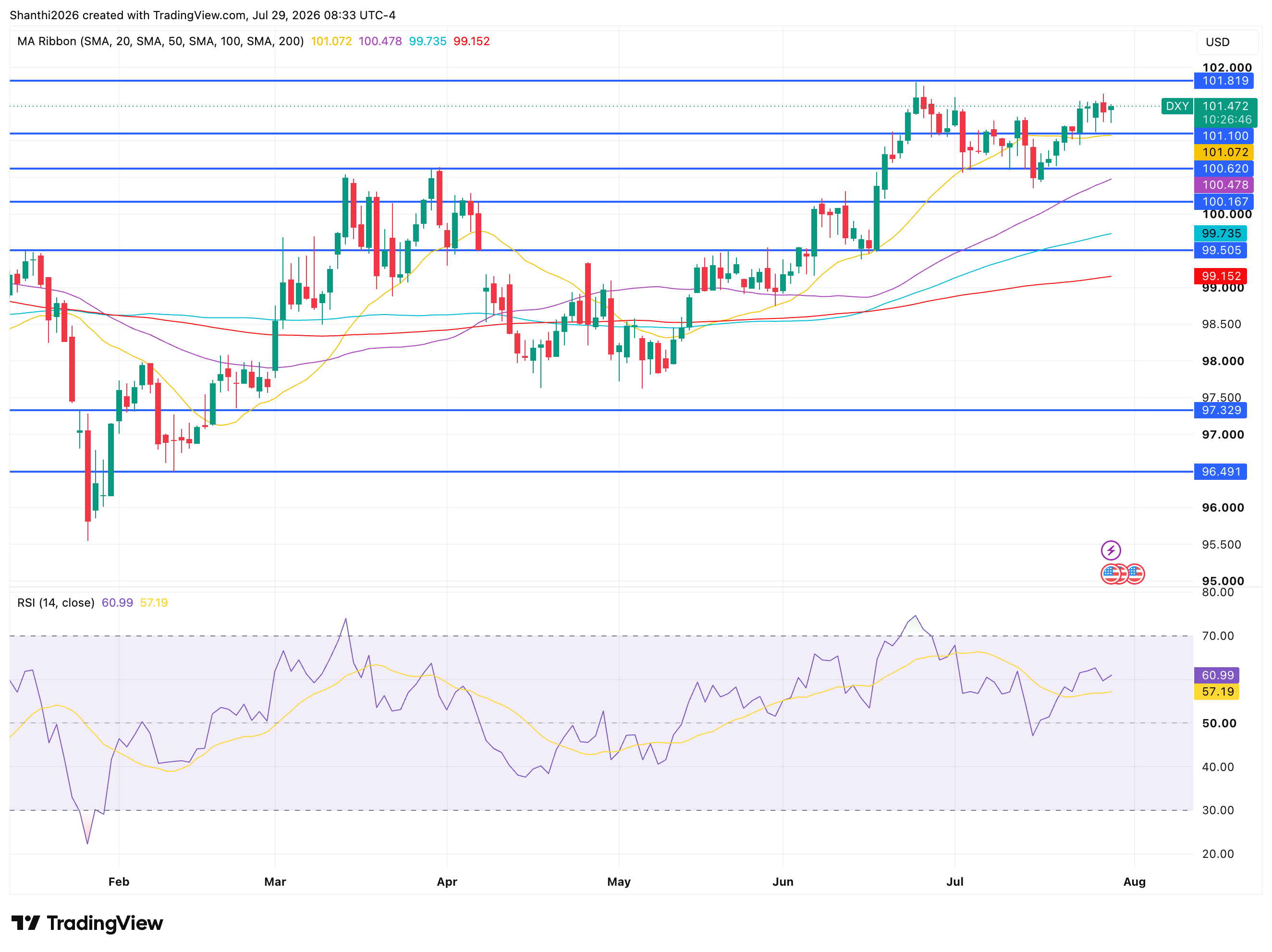
DXY was little changed Wednesday, last trading near 101.47, and boxed inside a well-defined 101.100–101.819 range that has capped price action since mid-July. That kind of stillness is unusual given everything else moving around it: Treasury yields ticked up to 4.629%, oil surged more than 5% on fresh Middle East tensions, and equity futures wobbled ahead of Big Tech earnings. The dollar, by contrast, has barely flinched.
That's the technical story in a nutshell — a market pricing in a binary outcome. Rather than drift ahead of the Fed, DXY has compressed into that 101.100–101.819 range, unwilling to commit to a breakout until the policy verdict is known. Tight pre-event ranges like this typically resolve with an outsized move once the catalyst hits, and today's setup is no exception.
According to MarketFramework’s Top Traded Contract tool, retail sentiment toward the Euro FX (6E) futures contract, which tracks the euro against the U.S. dollar, has been decisively bearish over the past seven days, reflecting strong bullish conviction on the dollar. Given that the euro carries a 57.6% weighting in the U.S. Dollar Index (DXY)—by far the largest component of the six-currency basket managed by the Intercontinental Exchange (ICE)—this positioning reinforces the broader bullish dollar narrative. Notably, 100% of profitable trades were short positions, suggesting that traders betting against the euro have consistently been on the right side of the market.
Why the Range Has Held
Part of the explanation lies in how balanced the outcome genuinely looks. Markets are assigning roughly a 38% probability to a rate move, while a September cut is priced at closer to 80%. That leaves Wednesday's meeting caught between two competing narratives: a Fed that stays on hold to preserve optionality, and a Fed under pressure, as Citadel Securities has argued, to hike and reinforce Warsh's inflation-fighting credibility.
With the market genuinely split on both the near-term decision and the messaging that follows, DXY has had little reason to pick a direction. The dollar's stillness reflects hesitation, not conviction.
The Street's Read: A Hold That Hurts the Dollar
Not everyone reads the setup as balanced. ING strategist argues the dollar's recent resilience, including its muted reaction to softer consumer confidence data and this week's oil-price slide, has been driven largely by precautionary positioning ahead of a possible surprise hike. With markets assigning only a 30% probability to that outcome, ING's base case is that a hold, its own expected result, should trigger a mechanical unwind of that positioning and a mechanical correction lower in front-end USD rates.
The bank flags the vote split as the real swing factor. If Dallas Fed President Lorie Logan and Cleveland Fed President Beth Hammack push for a hike, as consensus expects, year-end rate expectations may hold up even as downside risks for the dollar persist.
Absent a hawkish surprise from Warsh or more than two dissents, ING sees the hold as an opening for the dollar to "reconnect" with the signal from lower oil prices and, if Gulf headlines stay constructive, for DXY to test the 101.00 level by the end of the week. That's a notably softer read than the range-bound, binary-outcome framing above, and a reminder that a "hold" is not a non-event for the dollar. It can be a catalyst in its own right, just not the hawkish one some traders are hedging against.
What the Chart Structure Shows
The broader trend backs up the case for a coiled setup rather than a stalled one. DXY's moving-average ribbon is stacked bullishly, with the 20-day (101.072), 50-day (100.478), 100-day (99.735) and 200-day (99.152) all sloping higher and sitting in proper ascending order beneath spot. This is the textbook signature of an uptrend that has been intact since the index bottomed near 96.49 back in January.
Source: TradingView
The 14-day RSI reads 60.99, comfortably above the neutral 50 line but still well short of the 70 threshold that would flag overbought conditions. That leaves room for a hawkish-leaning outcome to push the index higher without immediately running into exhaustion, while a dovish surprise would test a market that isn't stretched on momentum either.
The Yield Disconnect Traders Are Watching
One wrinkle complicates the technical picture. DXY isn't tracking yields the way it normally would. The 10-year yield's move higher on Wednesday would typically lend some support to the dollar, yet DXY has stayed essentially flat. That divergence suggests either the yield move is seen as temporary — a geopolitical risk premium rather than a genuine repricing of Fed policy — or that dollar positioning is already fully loaded ahead of the decision, leaving little room to react to yields alone.
If that gap between yields and DXY persists after the Fed statement, it could be an early signal of how convincingly the market believes the decision.
What a Break Could Look Like
Heading into the announcement, the range around 101.40 effectively acts as the fulcrum.
- A hawkish hold or the surprise hike scenario some are floating would likely see the DXY push toward the top of its recent range and beyond, as short-dollar positioning unwinds quickly.
- A dovish hold, paired with a Warsh press conference that leans dovish, would more likely send DXY through the bottom of the range, extending the dollar's recent softness.
Options markets and cross-asset volatility (in equities and oil) suggest the market isn't expecting another quiet session once Warsh takes the podium.
The Bigger Picture
DXY's technical compression is a reminder that the dollar, more than most assets, trades on conviction about the path of policy rather than the immediate print. What moves DXY out of its range will be less about Wednesday’s vote itself and more about how convincingly Warsh signals, or resists signaling, the September hike trmarkets have already mostly priced in.
For traders, that makes the press conference, not the rate decision, the real catalyst to watch.