
U.S. equity markets opened the post-Labor Day week under pressure as a fresh escalation in the Middle East pushed WTI crude past $94 a barrel, its highest level in three months. The Dow suffered the sharpest decline, while the Nasdaq showed considerably more resilience, highlighting a growing divergence between economically sensitive stocks and technology. The Dow fell more than 1% Tuesday, compared with a 0.07% decline for the Nasdaq Composite. The Nasdaq-100 Index, comprising 100 of the biggest non-financial tech names, in fact edged up 0.21%.
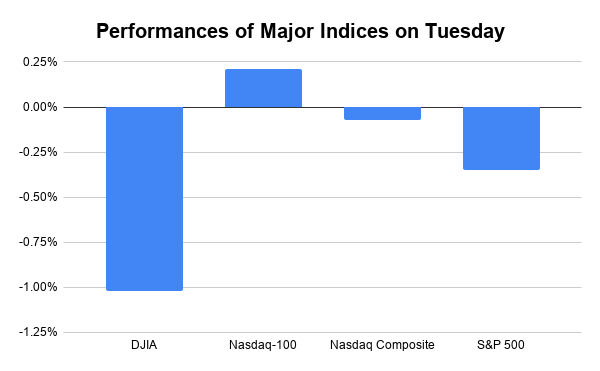
For futures traders, the more important question is whether this is simply a one-day reaction to the Saudi oil shock or the beginning of a tougher period for equities as higher energy prices collide with elevated Treasury yields and incoming inflation data.
Saudi Attacks Send Oil Higher
The immediate catalyst was a wave of Houthi attacks on southern Saudi Arabia that hit energy facilities and forced temporary operational shutdowns at some sites. Brent climbed toward $100 while WTI rose above $94, as the attacks raised fresh concerns about the reliability of regional energy supplies.
The market reaction is significant because crude had already rallied sharply in recent weeks. Another supply shock at this stage risks turning an oil rally into a broader inflation problem.
That is particularly important for equities because higher crude does not affect all sectors equally.
Why the Dow Is Taking the Bigger Hit
The Dow's heavier exposure to industrial, financial, consumer and other economically sensitive companies makes it more vulnerable to an oil-driven growth shock.
Higher energy prices can squeeze corporate margins, raise transportation and input costs and weaken consumer purchasing power. If the oil shock persists, the market could also begin pricing slower economic growth alongside higher inflation, the classic stagflationary combination.
The Nasdaq-100 has a different vulnerability. Its technology-heavy composition makes it particularly sensitive to interest rates and valuation multiples, but so far investors have been more willing to look through the oil shock because of continued enthusiasm around AI and technology earnings.
That explains the unusual setup: oil is rising, yields are rising, yet NQ is holding up better than the Dow.
The Bond Market Could Decide Whether NQ Keeps Holding
The bigger threat to the Nasdaq may not be oil itself but what oil does to Treasury yields.
The 10-year Treasury yield moved above 4.8% as investors assessed the inflation implications of higher energy prices. It has since retreated below the threshold.
That creates a second channel through which the oil shock can reach technology stocks. If higher crude pushes inflation expectations higher, traders may reduce expectations for easier monetary policy, lifting yields further.
The New York Fed’s August Survey of Consumer Expectations presents a mixed inflation picture. One-year inflation expectations held steady at 3.6% in August, while five-year expectations remained at 3.0% and three-year expectations edged down to 3.2%. But households became more concerned about several key costs, with year-ahead gasoline price expectations jumping 1.7 percentage points to 4.6%, the largest increase among the major commodity categories. Food, medical care, rent and college cost expectations also rose.
The combination is important for markets: while broad inflation expectations remain relatively anchored, renewed energy-price pressures could make the inflation outlook more difficult if the recent surge in oil prices feeds into household expectations and, ultimately, Treasury yields.
For NQ, that would matter because higher yields increase the discount rate applied to
future earnings and make high-duration growth assets less attractive.
So far, that transmission mechanism has been relatively contained. The key question is whether NQ can continue to absorb rising yields if oil keeps climbing.
The Next Two Weeks Could Be the Real Test
The timing makes the current market reaction particularly important. Investors are entering a data-heavy period with U.S. producer price inflation (PPI) due Thursday and consumer price inflation (CPI) on Friday, just days before the Federal Reserve's September 15-16 meeting.
That means the market could soon have to reconcile three forces:
Higher oil → higher inflation risk → higher yields → pressure on equity valuations.
If inflation data remain contained despite the energy shock, NQ's resilience could make sense. Investors could argue that the oil surge is primarily a temporary supply shock rather than a sustained inflation impulse.
But a hotter-than-expected inflation reading would make the current divergence much harder to sustain.
NQ's Resilience Faces a Bigger Test
The current market is therefore sending a mixed signal rather than a clean risk-off message.
The Dow is already pricing a meaningful portion of the economic damage from higher oil, while NQ appears to be betting that the energy shock will not become a lasting inflation or rates problem.
That makes the next move in oil and Treasury yields more important than the Dow's one-day decline itself.
If WTI prices remain elevated the 10-year yield pushes materially beyond 4.8%, NQ's ability to hold up could become increasingly difficult. But if crude stabilizes and inflation data fail to validate the worst-case scenario, the Nasdaq's relative strength could prove justified.
For now, the Dow-NQ divergence is less a signal that tech is immune to the oil shock than a test of how long investors can keep treating higher crude as a regional supply problem rather than a broader inflation problem.