Crude spent the session proving the thesis in real time: when a supply scare isn't actually barrels, the market prices the fear and then hands it back. WTI (CL) was pressed toward the $80 handle through the European morning on the demand side with fresh OPEC and IEA forecast downgrades and a heavy EIA build.
This was followed by a snap up to 82.40 midday on a Houthi claim of a drone strike on Aramco's Jizan refinery and hardening Iranian Hormuz rhetoric. But the bid faded into the U.S. close.
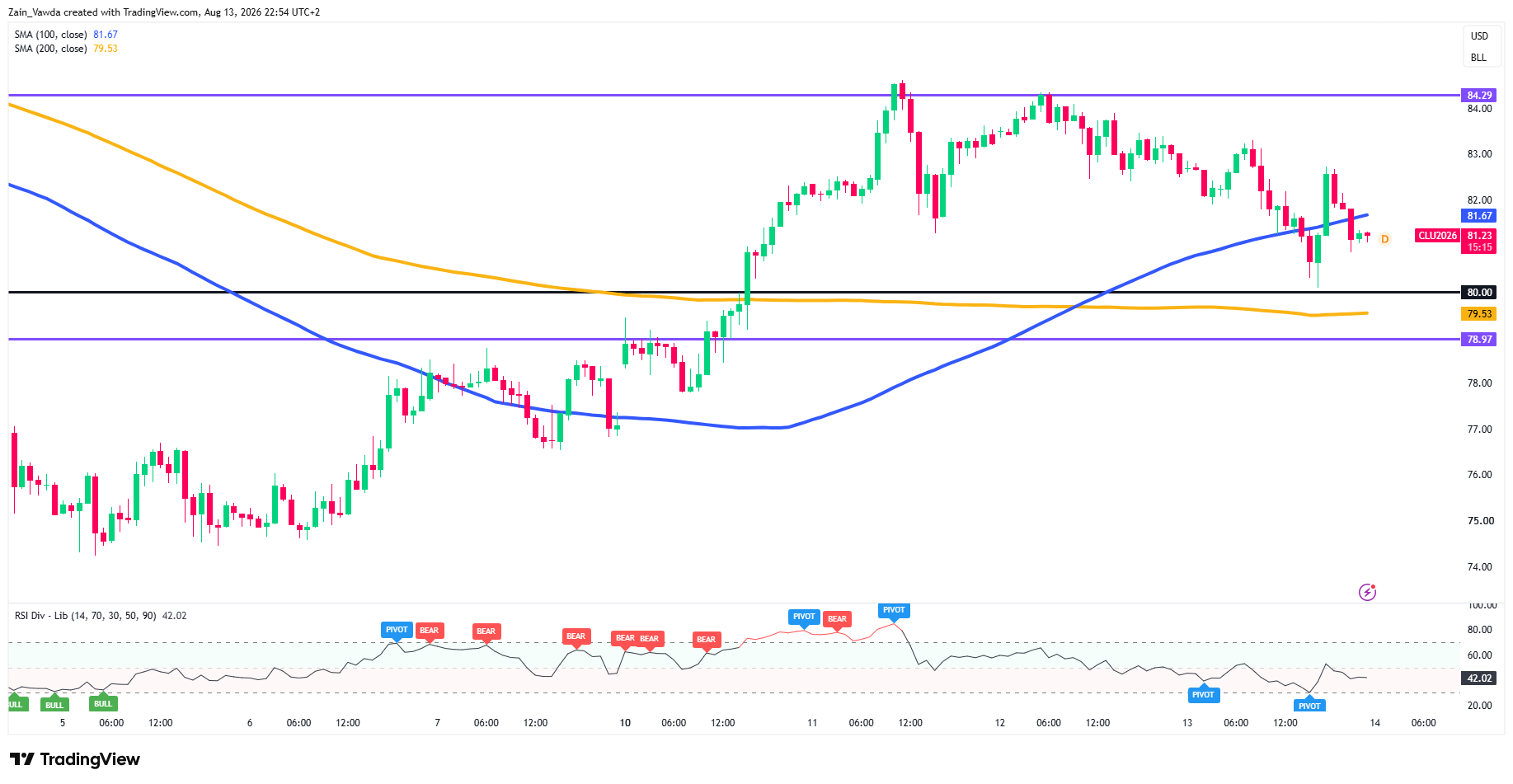
Price slipped back under the 100-MA to settle near 81.23, with RSI rolling from the low-50s back to 42. The round-trip is the story and it's exactly what a risk-premium move, rather than a supply-loss repricing, was always going to do.
The Tape: The Bounce Gets Sold, Back Below the 100-MA
On the H1, CL (81.23 ) remains range-bound between the 78.97 pivot and the 84.29 ceiling, and the session ends in the lower half of that band.
Price sold down from the 84.29 range top where RSI printed a bearish divergence on August 11, bounced off the $80.00 / 200-MA (79.53) floor on the midday geopolitical pop, then failed to hold it: the rally was sold back below the 100-MA (81.67), which now sits overhead as resistance rather than support.
RSI has rolled to 42.02, back under the midline, so near-term momentum is lower.
The broader 78.97–84.29 range is intact, but the tilt into the overnight is toward the floor the market is leaning on 80.00 / 79.53 again, and it's the reclaim of 81.67 that the bulls now need.
Oil (CL) One-Hour Chart, August 13, 2026
Source: TradingView
The Catalyst: A Claim, Not a Confirmed Supply Loss
The spark is a flash from the Houthi-run Saba News Agency that the group hit Aramco's Jizan refinery with two drones. Two caveats keep this in the risk-premium bucket rather than the supply-loss bucket.
First, it is single-sourced to Houthi media and tagged low-impact on the wires, no independent confirmation or Saudi damage assessment yet. Second, and more important for barrels: Jizan (400kbpd) has been largely offline since a July 27 strike damaged its gasification and tank-farm units, and Aramco's CEO has said recent attacks caused no material operational or financial impact.
So another hit lands on capacity that is already out. The marginal supply loss is small, which is why the pop had no staying power once the headline adrenaline drained.
The bigger lever sits alongside it: Iran is again hardening its Hormuz stance, with state outlets today asserting that no ship can safely transit the strait without approval and that Tehran fully controls the waterway. That plus the slow-burn Syria–Hezbollah escalation vector, where Iran has warned Damascus against moving on Hezbollah appears to be the structural risk premium under crude. Treat the specific threats as claims from partisan outlets, but the direction of travel is a market that has to keep a war premium priced while the Strait stays contested.
A third leg was added mid-session: the Wall Street Journal reports the US is moving a fresh carrier into the Middle East.
The USS Theodore Roosevelt strike group readying to relieve the USS Abraham Lincoln, which is straining through a roughly 264-day deployment that has drawn Congressional scrutiny over conditions aboard.
For crude, read the signal carefully: this is force sustainment, not a new offensive. Washington is rotating a carrier to keep the Hormuz blockade in place rather than winding it down which says the supply-risk floor stays under the market even on quiet-headline days.
It's structural support for the premium, not an acute spike catalyst, and it's a large part of why the demand bears can lean on rallies but haven't broken the range.
The Other Side: Why the Rallies Keep Getting Sold
The reason this is a range and not a trend is the demand overhang.
Both OPEC and the IEA have trimmed their 2026 demand outlooks, explicitly flagging high prices and Middle East uncertainty as a drag, and the latest EIA report showed a large US crude build, the fundamental backdrop that had price leaning toward $80 before the headline.
It also frames the ceiling: sell-side desks have argued crude moderates toward the low-$80s into year-end if Hormuz reopens, with Saudi-infrastructure and Red Sea attacks the main upside risk.
That is exactly the two-sided setup the chart shows, a demand-anchored top at 84.29, a geopolitics-defended floor at 80.00/79.49.
Will we get a breakout ahead of the weekend?


