
RBOB gasoline futures are caught between a falling national pump average and a crude market that has been gyrating. Traders looking for a clean read on where the futures curve goes next are instead staring at one of the widest forecasting bands, a reflection of just how much the market is being driven by geopolitics rather than fundamentals.
"It's been nearly impossible" to build a reliable predictive model right now, said Patrick De Haan, head of petroleum analysis at GasBuddy, in an interview with MarketFramework on Thursday. He pointed to the collision of two separate crises: escalating U.S.-Iran tensions around the Strait of Hormuz and Ukraine's sustained drone campaign against Russian refineries.
"A model will not be able to accurately predict how these different geopolitical situations may interact with each other."
The trade right now: oil down, pumps lagging
The national average sits at a little over $4 a gallon, and De Haan says it could fall to roughly $3.80 if crude prices hold steady, but traders should expect the retail market to lag the crude tape by several days. Oil losses take two to three days to reach most stations, De Haan said, and a full pass-through of a sustained decline can take one to three weeks given how gas stations cycle through underground storage.
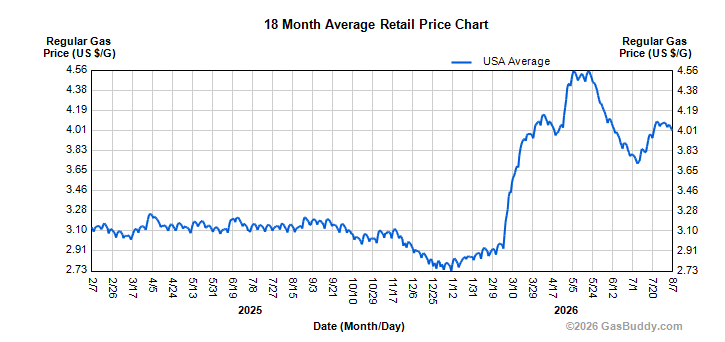
Source: GasBuddy
That lag is exactly why pump prices haven't caught up to this week's crude sell-off, when oil dropped nearly $6 a barrel before chopping back and forth. "With most stations now getting access to lower prices, they will start to lower prices by a few cents every day," De Haan said — but the transmission is mechanical, not immediate, and traders pricing retail-exposed names should model that delay into any short-term thesis.
After starting the week at over $80, WTI crude has come back from this level amid headlines that have been flowing in thick and fast.
Here are two paragraphs you can drop into the story — they'd fit naturally after the "Why oil rallied nearly 4% Thursday" section, since they reinforce the credibility/whipsaw theme:
Positioning data backs up the whipsaw thesis. Retail futures traders have crowded into crude shorts even as the tape has chopped violently in both directions. MarketFramework's Top Traded Contract toolshows "strong short" lean over the past seven days, with roughly two-thirds of positions betting on further downside versus a third staying long.
The split becomes clearer when the data is broken out by outcome. Among traders who closed the week in the green, roughly 94% were positioned long — while the losing cohort was dominated by short bets, at nearly 70%. It's a pattern consistent with De Haan's framing of a market driven by headline risk rather than fundamentals.
Two geopolitical risks, roughly equal weight
De Haan pushed back on the idea that one conflict dominates price action. The Strait of Hormuz threat is primarily a crude-price story, since oil supply can normalize quickly if the strait reopens. Ukraine's refinery strikes are a different animal, a refined-products story that could keep global refining capacity impaired "for a period of several weeks or several months."
That split explains why the crack spread, i.e. the gap between crude and refined product prices, has been "historically high," he said, and why diesel has decoupled sharply from gasoline. Russia has historically supplied roughly one in nine barrels of global diesel exports; with Russian refining capacity under sustained attack, Moscow has moved to ban diesel exports outright, adding a second layer of tightness on top of the refinery outages themselves.
"As of the last several weeks [the two conflicts] have almost been equally impactful," De Haan said, effectively splitting the geopolitical risk premium 50/50 between crude and cracks.
The tape underneath: refineries maxed out, inventories thin
The latest EIA data — crude stocks up 2.5 million barrels but still about 6% below the five-year average, gasoline inventories down and running roughly 7% below average — is unfolding against refinery utilization at 96.5%, De Haan noted, calling it the eighth or ninth straight week above 95%. "That's never happened before," he said. Refiners globally are running flat-out in part to backfill the capacity knocked offline in Russia, even as product inventories stay thin — a setup that keeps crack spreads structurally supported regardless of where crude settles.
Why oil rallied nearly 4% Thursday — and the credibility problem
Perhaps the most trade-relevant line of the interview: De Haan's read on why crude was bid up almost 4% on the day, even as the broader trend has been lower. The Trump administration has been "touting an agreement to reopen the strait," he said, but "there have been very little concrete developments," and the market is now "likely losing patience" and "starting to question the credibility of the administration."
In other words, the reflation trade isn't about tightening supply; it's a repricing of political risk after weeks of "more talk than action." De Haan said further upside in crude from here hinges on "whether or not the administration starts to give the market breadcrumbs on what's developing and the credibility behind the information that we're getting."
He also flagged a precedent bears should keep in mind: a prior ceasefire announced roughly two months ago "didn't hold up." Even if a durable deal is reached, De Haan estimates it would take one to three months for oil flows through the strait to normalize, and another one to three months beyond that before global inventories rebuild in a healthy way — pushing a full market recovery out "several months beyond" into 2027.
The Labor Day setup traders should watch
Asked for a seasonal marker, De Haan gave a genuinely two-sided range: the national average could be as low as $3.60 a gallon by Labor Day if the Hormuz deal materializes, or back up near $4.25 if it doesn't. "It's a pretty big window," he said, "but where prices are on Labor Day at the pump is very much completely contingent on whether or not this deal that the administration is touting happens."
The tail risk: China re-enters the bid
The wild card De Haan flagged last is arguably the fattest tail in the trade. China has been sharply curbing crude imports, and nobody knows when Beijing comes back to the market. If Chinese demand snaps back while the Strait of Hormuz remains constrained, De Haan said, "that could be very problematic and it could lead oil prices to rise back above $100 a barrel" — a scenario that would blow through his base-case Labor Day range entirely.


