The US–Canada trade fight stopped being background noise this weekend. Washington's 50% tariffs on a wide range of Canadian goods went live, Ottawa set a retaliation date, and the loonie finally moved.
USD/CAD is caught between two opposing forces: tariffs pushing it up, oil pulling it down and which one wins is the real trade here.
What Just Happened
Over the weekend the U.S. switched from threats to action.
On Saturday, 50% tariffs took effect on a broad list of Canadian imports, roughly $20 billion of goods, from farm products to hockey sticks after trade talks collapsed on Friday.
Canada didn't blink: Prime Minister Mark Carney promised to hit back “dollar for dollar,” with retaliation set to begin on Sept. 8.
Then on Monday, President Trump turned the screw again, saying tariffs on all Canadian cars, trucks, auto parts and steel will rise to 50% from 1 January 2027.
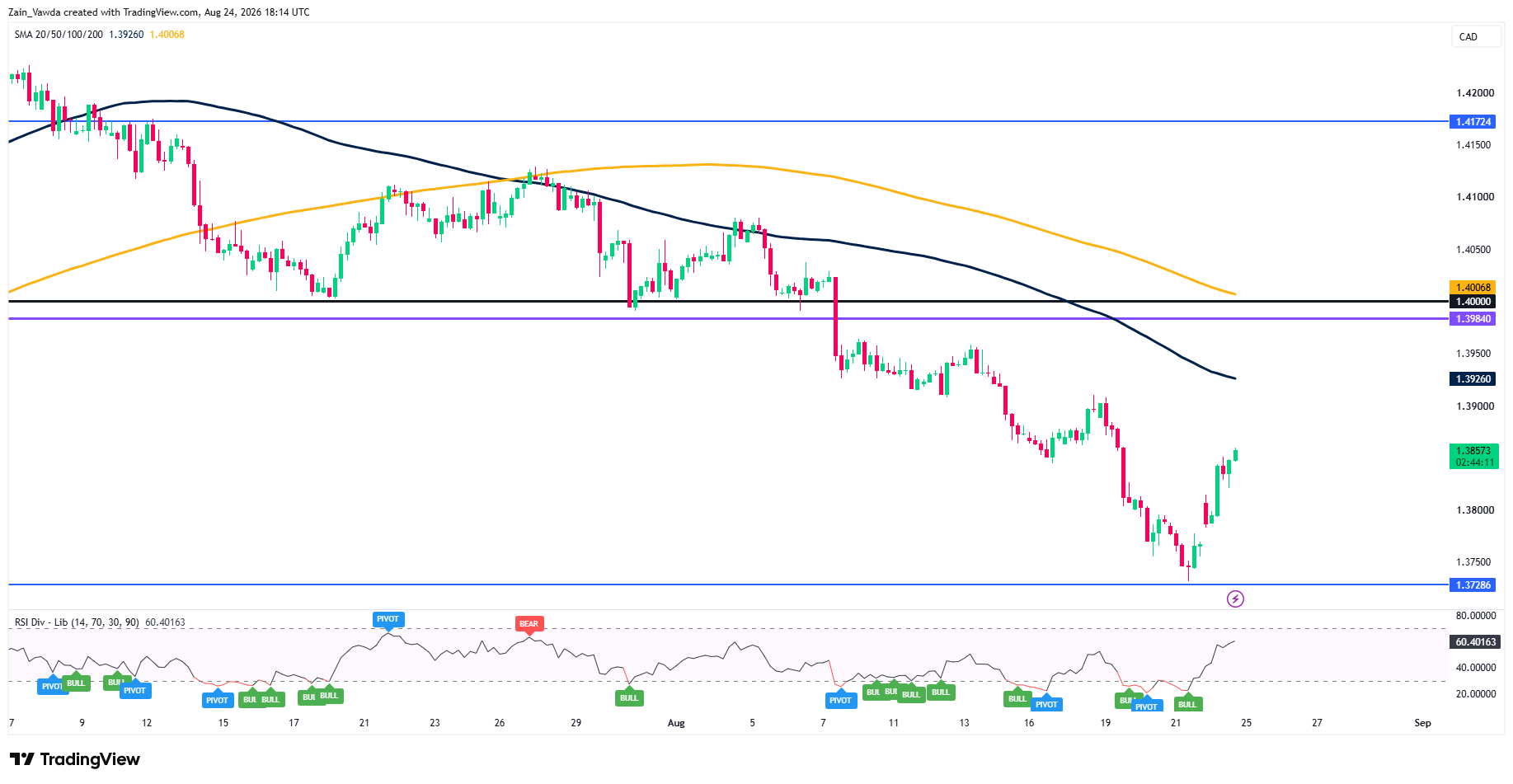
In plain terms, this is no longer a one-off, it is a scheduled, escalating fight with a clear next date on the calendar. The loonie weakened in response, with USD/CAD climbing about 0.5% to near 1.3830. (Remember: when USD/CAD rises, the Canadian dollar is getting weaker.)
USDCAD Four-Hour Chart, August 24, 2026
Source: TradingView
Why the Loonie Usually Fights Back: Oil
Here is the twist that makes this more than a simple “tariffs equal weaker CAD” trade.
Canada is one of the world's biggest oil exporters, and the Canadian dollar tends to move with the price of crude. Pricier oil means more money flowing into Canada, which supports the currency.
Right now oil has a bid: the Iran conflict has disrupted the Strait of Hormuz for nearly six months, keeping a risk premium in the price. So the loonie is fighting a two-front war.
Tariffs are a straightforward negative, but the oil bid is a quiet positive pulling the other way. That tension is exactly why USD/CAD has climbed without running away, the two forces are partly cancelling out.
It also fits a pattern this desk has flagged before: USD/CAD is the one major where the usual oil-and-dollar relationship gets complicated, because oil strength props up the “commodity” side of the pair.
What Decides It: September 8 and the Oil Tape
The next leg is a straight contest between the tariff calendar and the crude tape. If Canada's retaliation lands as promised on Sept. 8, and oil's risk premium fades, the tariff side wins and USD/CAD can break its resistance.
If oil catches a fresh bid out of the Middle East, the loonie's petro-currency support can cap or even reverse the move. In the background, the Bank of Canada looks content to sit on its hands, which removes one potential source of loonie support (rate hikes) from the picture and quietly tilts the odds toward a weaker CAD if the oil offset ever slips.
Potential Scenario Matrix
| Pair Move | Trigger - Spet. 8 and Oil | Levels to Watch |
|---|---|---|
| USD/CAD ↑ CAD weaker | Retaliation escalates on Sept.8 as promised and oil's risk premium fades / Hormuz calms. | Break and hold above 1.3846, opening 1.3929 then 1.4009. |
| RANGE two forces cancel | Tariffs largely priced and the oil bid offsets them — neither side takes control. | Capped under 1.3846, supported above ~1.3750. Range trade, no chase. |
| USD/CAD ↓ CAD stronger | A fresh Hormuz / Iran oil shock, or credible talk of an off-ramp on tariffs. | Oil side wins; pair rolls back toward 1.3750, then 1.3700. |
This is a headline-driven pair right now.
The classic unprofitable move is chasing the tariff spike at the highs, buying USD/CAD on the news candle with no plan for the oil offset that keeps snapping it back. The more profitable behaviour is respecting the resistance: waiting for a decisive break and hold above 1.3846 before pressing the tariff trade, or fading into the 1.3750–1.3700 support if oil takes charge, risk defined against a clear level either way.


