
The ECB left all three rates unchanged on Thursday, then spent the following hour building the case against its own decision. Lagarde stopped short of pre-committing to September — but not far short. The euro fell anyway.
What Actually Changed
The deposit rate was held at 2.25%, main refinancing at 2.40%, marginal lending at 2.65%. Lagarde confirmed the decision was unanimous — but also that a hike was argued for in the room. Unanimity on the outcome alongside division on the direction of travel is the tell.
Two language changes matter more than the decision itself.
The first is that risks to inflation and growth are no longer characterised as more balanced. Lagarde separated them instead, flagging upside risk to inflation against downside risk to growth. ING's Carsten Brzeski read that as a clear hawkish shift, and it is difficult to read it any other way.
The second is procedural: staff have been instructed to model oil and gas price scenarios in depth ahead of September. Central banks do not commission scenario work they intend to ignore.
Lagarde was direct on the shock itself, saying its full effects “have yet to play out.” She called the latest Red Sea attacks alarming while noting they landed after the Council had concluded deliberations.
The Case for September
The reaction function is now close to mechanical. The ECB published its logic in June, tying policy to explicit energy scenarios. Three weeks ago, with crude below $70, an additional hike looked unnecessary. Near $100 it looks close to unavoidable. Brzeski's framing is that the question has inverted — not what would move the ECB to hike, but what could now stop it.
July was never the meeting. Projections are published in March, June, September and December, and without a fresh forecast round to anchor a move, the July bar was structurally higher. The ECB has also spent years cultivating a habit of not surprising markets. September 10 carries new projections. That is the vehicle.
The June numbers already leaned hawkish before the latest move in crude. That round revised 2026 headline inflation up to 3.0% from 2.6% in March and cut GDP growth to 0.8%. Lagarde now expects inflation above target into the first half of 2027. Feed $100 Brent and a European gas market up 45% in a month into that arithmetic and the September projections make the argument without her.
Then there is credibility. Markets have priced September as near-settled, with MUFG noting the strip carries two to three further hikes. A central bank that already moved once into this shock does not lightly disappoint that pricing.
What Would Stop It
The counter-case is not weak. It rests on one variable and one asymmetry.
The variable is oil. Every strand of the hawkish argument routes through crude — and crude is currently a headline instrument rather than a fundamental one. US inventories built across every major category last week and the price rallied anyway. A credible ceasefire returns Brent to the $70s and takes the September hike with it.
The asymmetry is growth. GDP at 0.8% and a June composite PMI sitting exactly on the 50.0 line describe an economy at stall speed. Hiking into an energy shock applies a demand-side instrument to a supply-side price rise, and the second-round evidence in wages and core services remains thin.
Morgan Stanley's Jens Eisenschmidt is among those arguing inflation normalises sooner than the hawks expect. Today's flash PMIs are the first live test.
SCENARIO MATRIX · NEAREST CATALYST: 10 SEPTEMBER PROJECTION ROUND
| Path | Condition | Market Implications |
|---|---|---|
| Hike | Brent holds above roughly $85 into September; staff revise 2026-27 HICP higher; second-round effects appear in negotiated wages. | 25bp to 2.50% on 10 September. Bund yields extend, EUR/USD tests 1.1474 then 1.1501, but the US-EZ spread caps the follow-through. |
| Hold | A credible ceasefire returns Brent to the $70s; core continues cooling from 2.8%; growth data deteriorates sharply | Rates unchanged and June framed as sufficient. The strip unwinds two to three hikes, EUR/USD back toward 1.1361 and Bunds toward 3.05%. |
| Hike and Guidance | Winter gas refill compounds the oil shock; HICP re-accelerates back above 3%. | 25bp plus explicit signalling toward October. The strip prices 2.75%, Bunds break higher, and the euro finally gets a rate story it can hold. |
What the Charts Say
The reaction was the tell. EUR/USD fell 0.26% to around 1.1385, breaking back below 1.1400 on a meeting that all but confirmed September.
The ECB supplied the hawkish signal and the dollar took the session anyway, bid on safe-haven flow as the Middle East escalated.
The binding constraint is not technical: a US-eurozone yield gap of roughly 125 to 150 basis points, which is why June's hike bought the euro almost nothing either.
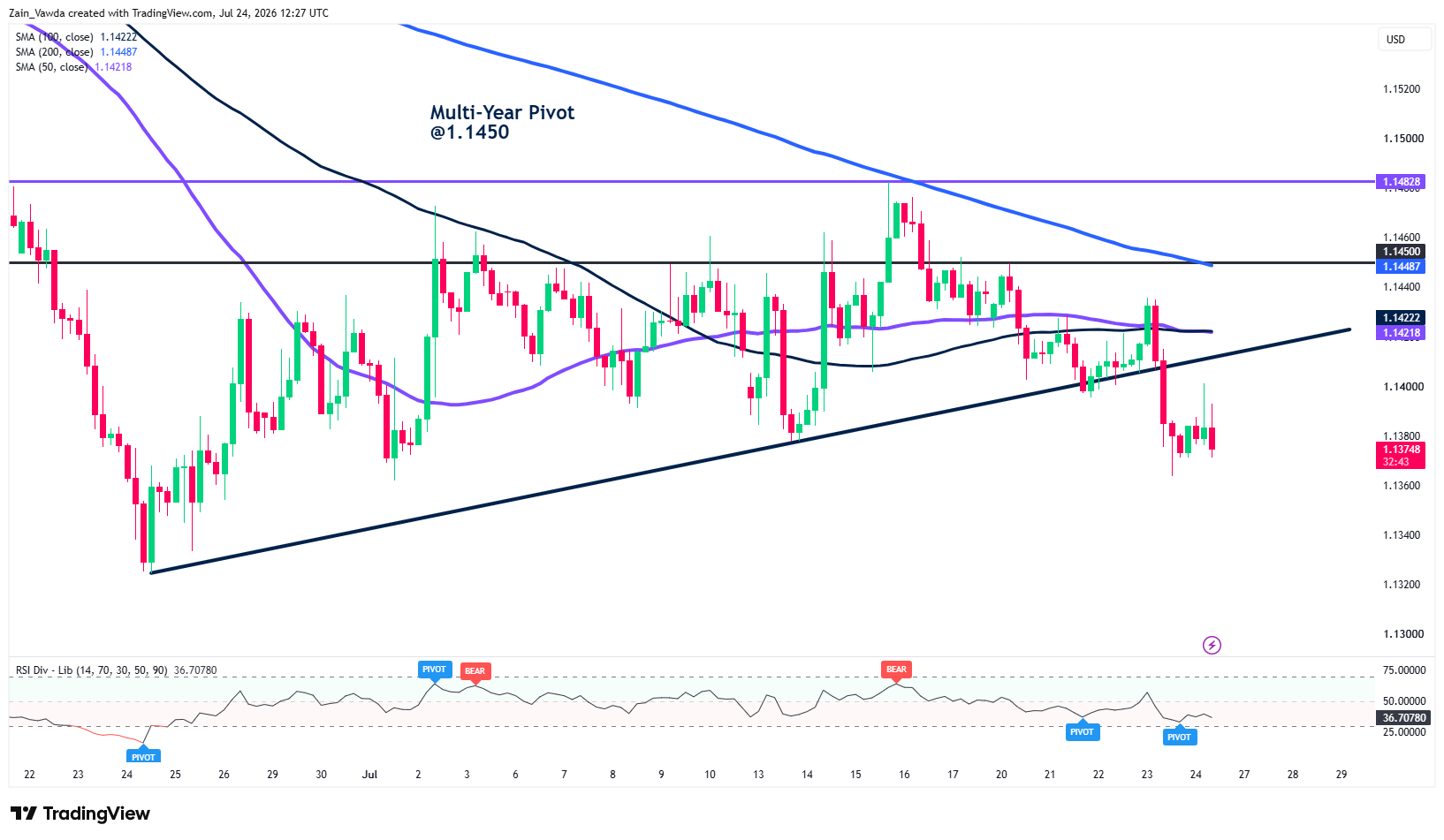
EUR/USD Four-Hour Chart, July 24, 2026
Source: TradingView
The ascending support line off the late-June low near 1.1320 has broken. Price failed to reclaim it on Thursday's bounce and now trades at 1.13748, turning that structure into resistance.
The moving averages are stacked overhead and tightly clustered: the 50-MA (1.14218) and 100-MA (1.14222) sit almost on top of one another, with the 200-MA at 1.14487 reinforcing the multi-year pivot at 1.1450.
That confluence caps any recovery.
RSI at 36.71 has printed successive pivot lows without a bullish divergence — momentum still favours sellers.
Downside focus falls on 1.1360, then the 1.1320 origin of the broken trendline. Bulls need a 4H close above 1.1422 to neutralise the breakdown.