Nasdaq-100 E-mini futures (NQ) are heading into Apple’s biggest product event in years with the market facing two powerful macro headwinds: oil above $95 a barrel and the 10-year Treasury yield atop 4.80%. That leaves Apple’s September keynote unusually important for NQ traders. A strong product launch could provide a company-specific catalyst for tech stocks, but it will have to overcome a macro backdrop that has recently been driving the index lower.
Apple’s “Surprise and Shine” event on Wednesday marks the first major product launch under new CEO John Ternus, who succeeded Tim Cook on September 1. The company is widely expected to unveil its first foldable iPhone alongside premium iPhone models, potentially making this the most significant change to the iPhone lineup since the iPhone X.
Morgan Stanley analyst Erik Woodring called the event as “Apple’s most consequential iPhone launch since iPhone X.” The tech analyst highlighted the following as three details he would watch out for closely as they will dictate how Apple trades through year-end:
- How Ternus performs in the spotlight
- Whether the Foldable phone’s hardware and software experience can catalyze demand
- How Apple balances higher prices with affordability, margins and demand across both new and legacy iPhones
Foldable iPhone Could Reset the Apple Growth Story
The foldable iPhone is the key attraction. Woodring sees the form factor contributing about $14 billion to December quarter’s topline. He expects strong initial foldable demand and constrained supply, forecasting 7.8 million builds in the second-half of the calendar year 2026 and up to 20 million over the first product cycle. The Morgan Stanley analyst expects the foldable iPhone to begin shipping later, either in late October or early November, and the pricing to be around $2,400.
For every 1% of foldable in the iPhone mix, there would be a 1.5 percentage point of average selling price (ASP) tailwind, all else being equal, Woodring said. He, however, highlighted some tradeoffs, including the absence of Face ID and the lack of a telephoto camera, leaving only wide and ultra-wide rear cameras.
More importantly, Apple is entering a market where Samsung, Google and Huawei have already established products, but its late arrival could be deliberate: the company has had years to refine the technology while competitors exposed the durability, crease and usability problems associated with early foldables.
That matters for investors because the potential upside extends beyond the device itself. A successful foldable could create a new premium upgrade cycle, expand Apple's addressable market and give investors a fresh hardware-growth narrative at a time when much of the technology sector's valuation story remains tied to AI.
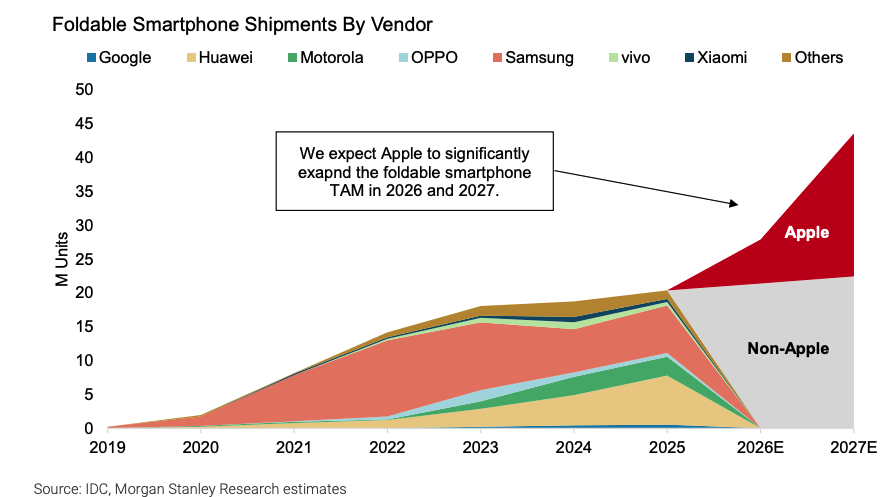
Despite the priciness, analysts expect Apple to capture a significant share of the still-small foldable market if the product delivers on design and functionality. Morgan Stanley sees Apple’s entry to nearly double the foldable smartphone market by the calendar year 2027.
Foldable Phone — Market Potential
Source: Morgan Stanley
What Else is New
The other products to be announced include:
- iPhone 18 Pro
- iPhone 18 Pro Max
- Apple Watch Series 12
- Apple Watch Ultra 4
- AirPods 5
Morgan Stanley does not expect the base iPhone 18, or iPhone Air 2 to launch at the event, with the likely unveils during the next Spring event.
Bloomberg columnist and Apple specialist Mark Gurman also listed an array of new products that could launch either on Wednesday or in October. These include a smart home hub, a new Apple TV, an updated HomePod mini, an iPad mini with an OLED screen, an M6 iMac, an M6 14-inch MacBook Pro and Apple’s first touch-screen MacBook.
The iPhone 18 Pro and Pro Max will likely be armed with A20 Pro processors, in-house C2 modems, better battery life and improved vapor chambers to prevent overheating. Camera upgrades are also expected.
Ternus Has More Than a Product to Sell
The event is also a leadership test. Ternus spent years running Apple's hardware organization, meaning the foldable launch is closely connected to the product strategy he helped oversee. But Wednesday will give investors their first major opportunity to assess how he communicates Apple's next phase as CEO.
The market will therefore be listening for more than specifications. Guidance around demand, pricing, margins, supply constraints and the broader product roadmap could matter more for Apple's stock than the novelty of the foldable itself.
That distinction is particularly important for NQ. A visually impressive keynote could generate an initial Apple rally, but traders will need evidence that the product can translate into incremental revenue and earnings rather than simply shifting consumers from existing iPhones into a much more expensive model.
How Apple’s Stock Trades Amid iPhone Launch Events
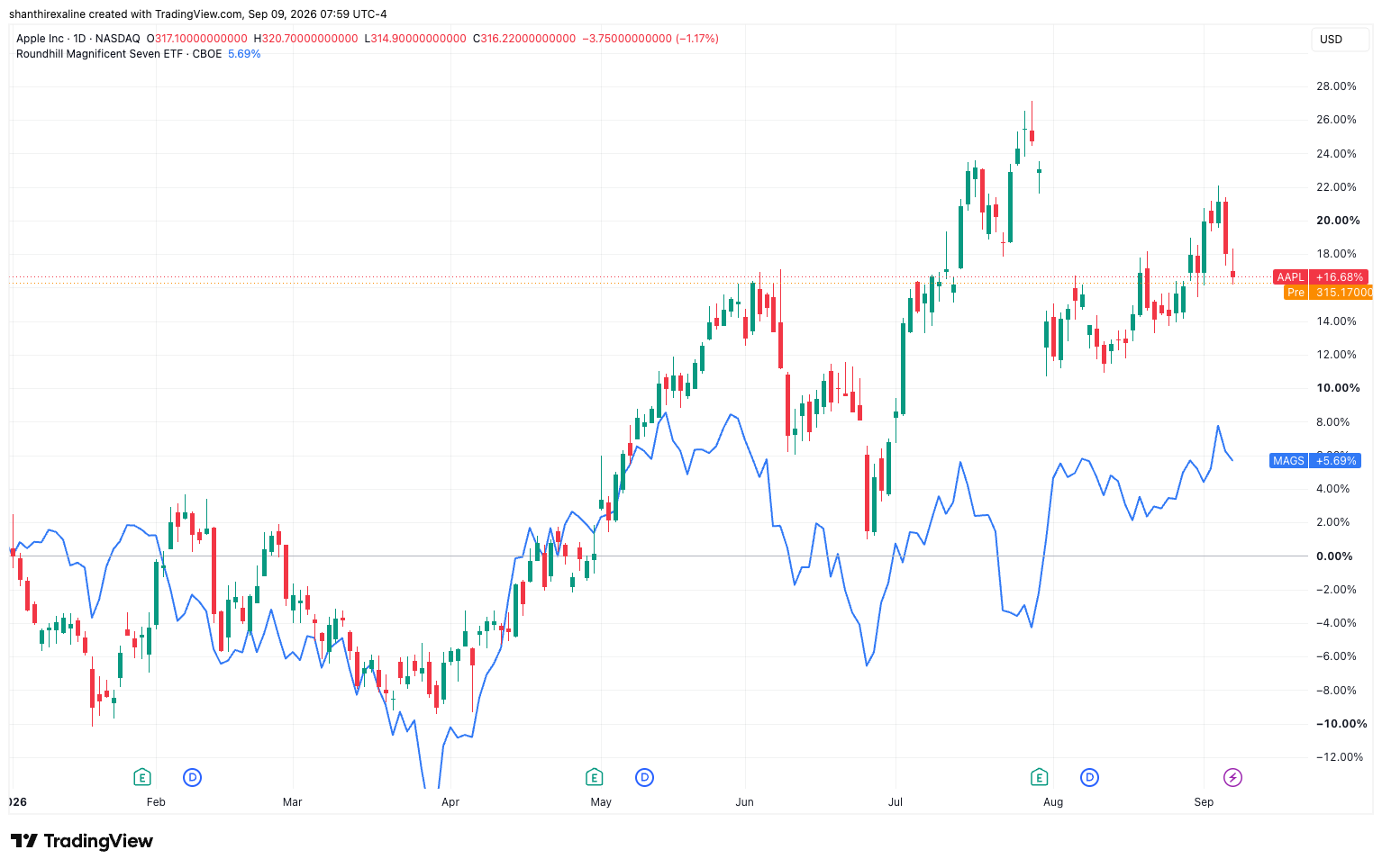
Apple has outperformed its Magnificent Seven peers so far this year, skirting the artificial intelligence-related volatility, being the least exposed to the technology.
Source: TradingView
Keeping with the typicality, Apple shares could underperform in a “sell-the-news” move. Delving into what happens in the one to three months after the launch, Woodring said he is positive.
“Given our excitement around the Foldable and ASP tailwinds more than offsetting an elasticity response - and the likelihood of a Siri AI launch in October - we lean more positively than negatively.”
That said, the analyst sounded a note of caution. With the stock trading at more than 30 times the forward price-earnings (P/E) multiple, the key to outperformance going forward will be positive estimate revisions. If demand for the newest iPhone line-ups do not align with the builds in the second-half and next year, the stock could face the same fate as in 2022, when it fell 7% in 30 days following the launch, Woodring said.
Can Apple Overcome Oil and Rates?
That is where the broader market backdrop becomes critical.
Brent crude has moved toward $100while WTI is above $94 as the Iran conflict continues to threaten energy supplies through the Strait of Hormuz. At the same time, the 10-year Treasury yield has pushed above 4.80%, keeping pressure on growth-stock valuations. U.S. stocks fell Tuesday as the oil surge revived inflation concerns and complicated the Federal Reserve outlook.
For NQ, Apple's event could therefore provide a micro catalyst against a macro headwind. With an 11.07% weighting in the Nasdaq-100, Apple has enough influence to move the entire index in the direction of its stock price. If the keynote generates a strong response in Apple shares, it could lift the Nasdaq-100 and give technology stocks some breathing room. But if investors focus on the foldable's high price, limited initial availability or the lack of a major earnings catalyst, the event may fail to change the broader risk narrative.
MarketFramework's Positioning Edge tool shows a mild bearish divergence, with profitable traders 57.7% long versus 61.7% long among unprofitable traders. The 4-percentage-point gap suggests that while both groups remain net bullish, profitable traders are displaying slightly more caution as the index trades lower. Unlike stronger divergence signals where successful traders are aggressively positioned against the crowd, this setup points to a market lacking a clear sentiment edge.
What NQ Traders Should Watch
The bullish scenario is straightforward: Apple delivers a compelling foldable, investors embrace the new product cycle and Apple shares help stabilize the Nasdaq despite elevated oil prices and Treasury yields. That would give NQ a reason to rally that is independent of hopes for lower rates.
The bearish scenario is equally important. If oil remains elevated and yields continue climbing, a positive Apple keynote may produce only a short-lived reaction. In that case, traders could view any NQ bounce as an opportunity to sell rather than the beginning of a broader recovery.
For NQ, Wednesday's question is not simply whether Apple can impress consumers. It is whether Apple's new product cycle can become strong enough to temporarily overpower the two forces currently dominating tech valuations: oil-driven inflation risk and higher Treasury yields.