
As Treasury yields climb alongside America’s growing debt burden, investors face a question that could shape the next phase of the bull market: when does fixed income become attractive enough to pull capital away from equities?
The $40 trillion U.S. government debt milestone has not, by itself, triggered a broad risk-off reaction. Instead, it is raising a more consequential question for asset allocation: whether persistently high borrowing and rising yields eventually change the relative appeal of stocks and bonds.
The $40 Trillion Milestone Is Just the Starting Point
U.S. government debt has surpassed $40 trillion, having doubled over roughly the past decade. LPL Financial notes that the debt-to-GDP ratio is around 123%, near historic highs, while persistent fiscal deficits, higher borrowing costs and spending pressures are keeping the trajectory elevated.
But the size of the debt alone may not be the immediate problem for markets.
Morgan Stanley Global Head of Fixed Income Research Andrew Sheets argues that private-sector balance sheets remain comparatively healthy. U.S. corporate debt relative to GDP has been broadly unchanged over the past decade, while household debt is around 67% of GDP, below both 2000 and 2019 levels. That resilience has allowed consumers and companies to absorb higher borrowing costs better than many investors expected.
That helps explain why markets have so far looked through the $40 trillion headline.
The bigger issue may be what happens to the price of capital as the government continues borrowing.
Bonds Are Offering Competition Again
This is where the debt story becomes an asset-allocation story.
Long-term Treasury yields have climbed sharply, with LPL Financial reporting the 10-year Treasury near 4.7% and the 30-year yield above 5.3% in recent weeks. LPL says investors appear to be demanding greater compensation for holding longer-dated government debt amid concerns about Treasury supply and persistent fiscal deficits.
Morgan Stanley's analysis puts the competition with equities even more directly: 30-year Treasuries were offering roughly 300 basis points above expected inflation, while long-dated U.S. investment-grade bonds were yielding around 6.2%.
That is a very different backdrop from the ultra-low-rate era, when investors were pushed toward equities because high-quality bonds offered little income.
The question now is not simply whether bonds are attractive in isolation. It is whether they are becoming attractive relative to the risk investors take in stocks.
Stocks vs. Bonds: The Yield Gap Is Narrowing
10-year U.S. Treasury yield vs. S&P 500 earnings yield
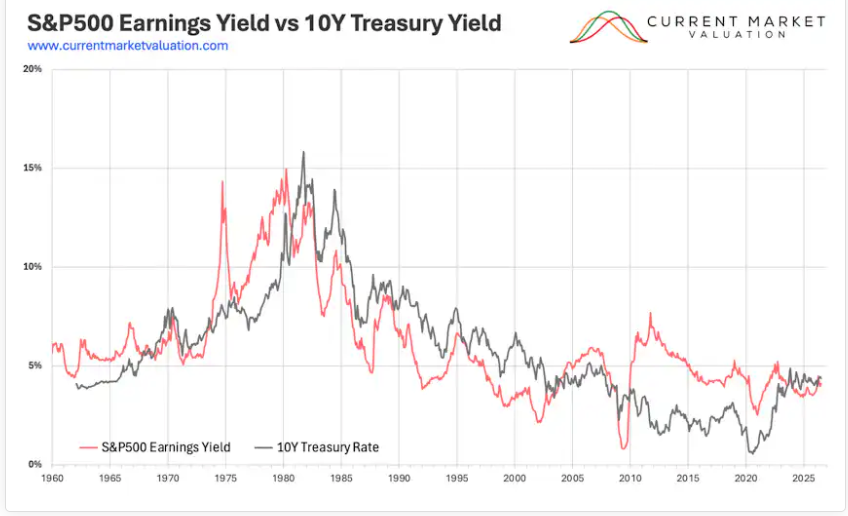
Source: Currentmarketvaluation.com
Why Stocks Haven’t Lost the Battle Yet
So far, equities are still holding their ground.
Morgan Stanley says fund-flow data and market correlations do not show a significant reallocation away from equities despite higher bond yields. One reason is earnings: strong corporate profit growth has helped offset the valuation pressure created by higher interest rates, leaving the equity risk premium broadly unchanged.
That creates an important dividing line for the market.
If earnings continue to expand, stocks can potentially justify higher valuations even as Treasury yields remain elevated. But if earnings growth slows while long-term yields stay high, the calculation changes.
Investors would then have to ask why they should accept the volatility and uncertainty of equities when high-quality bonds offer substantially higher income than they did a few years ago.
The Trigger May Be Earnings, Not Debt
This may be the most important takeaway from the $40 trillion milestone.
Morgan Stanley's Sheets argues that the point at which higher yields begin to matter may have less to do with companies stopping investment or consumers cutting spending and more to do with investors deciding that bonds offer better value than stocks.
That distinction matters.
A debt-driven market disruption is not necessarily required for a rotation to occur. Bonds could gradually become more competitive simply because their yields remain high while equity earnings expectations moderate.
In other words, the catalyst for a stock-to-bond rotation may not be a Treasury crisis. It could be a relative-value shift.
Long-Term Yields Are Already Sending a Signal
The bond market is already showing signs that investors want more compensation for taking duration risk.
LPL points to the rise in long-term Treasury yields, noting that inflation, geopolitical tensions and heavy capital spending associated with the artificial-intelligence boom have added to upward pressure on yields and the term premium.
The recent Treasury buyback announcement also illustrates the difficulty of addressing the problem through market operations alone. LPL said the proposed increase in longer-dated bond buybacks from $2 billion to $4 billion initially pushed yields lower, but the move faded as investors viewed it largely as a reshuffling of the government's maturity profile rather than a solution to the underlying fiscal and supply pressures.
That suggests investors remain focused on the bigger picture: how much debt needs to be issued, at what yields, and who will ultimately absorb it.
What a Rotation Into Bonds Would Mean
A meaningful shift toward fixed income would matter well beyond Treasury markets.
Higher long-term yields can raise borrowing costs across the economy, from mortgages to corporate debt. They can also pressure equity valuations by increasing the discount rate applied to future earnings.
The effect would likely be most pronounced in the parts of the equity market whose valuations depend heavily on future growth and therefore are particularly sensitive to changes in interest rates.
But LPL's research offers an important counterpoint: higher government deficits have not historically prevented both stocks and bonds from producing positive returns over long periods. Its analysis found the S&P 500 posted positive returns in 17 of the 22 years examined when the deficit increased year over year, while the Bloomberg U.S. Aggregate Bond Index was positive in more than half of those periods.
That argues against treating $40 trillion of debt as an automatic sell signal for equities.
The Real Contest Is Between Yield and Growth
The $40 trillion debt milestone therefore may be less important as a standalone crisis indicator than as a marker of a changing investment landscape.
Morgan Stanley's central observation is that the critical question may not be when higher borrowing costs force consumers or companies to retreat, but when higher bond yields finally persuade investors to move their money.
For now, that threshold has not clearly been reached.
Stocks still have the advantage of earnings growth and long-term capital appreciation, while bonds now have something they lacked for much of the previous decade: meaningful income and a credible claim on investor capital.
That makes earnings growth the variable to watch.
If profits continue to rise, equities may remain competitive against increasingly attractive bonds. If earnings momentum fades while the 10-year and 30-year Treasury yields remain elevated, the $40 trillion debt story could take on a very different meaning.
The question for the next phase of the bull market may therefore be less “Can the U.S. finance $40 trillion of debt?” and more “At what yield do investors decide they no longer need to take equity risk?”


