
Updates to include category-wise retail sales growth and economist's view
Two reports released Thursday suggested that the U.S. economy is still showing underlying strength, even as the ongoing conflict involving Iran is adding fresh inflation pressure just when price growth had started to moderate.
Retail Sales Meet Expectations
U.S. April retail sales rose 0.5% month over month (MoM), slower than the 1.6% increase in March (revised from 1.7%), a Census Bureau report showed. The sales pace aligned with the growth expected by economists. Here’s how the inner details of the report panned out.
- Retail Sales, excluding autos: 0.7 Vs. 1.9% in March
- Retail Sales, excluding gasoline and autos: 0.5% Vs. 0.7% in March
- Retail Control group: 0.5% Vs 0.8% in March (consensus 0.4%); This is a measure of underlying consumer demand as it strips off sales of volatile components such as autos, gasoline and building materials.
- Retail Sales (year-over-year growth): 4.87% Vs. 4.15% in March
Retail Sales (MoM Change)
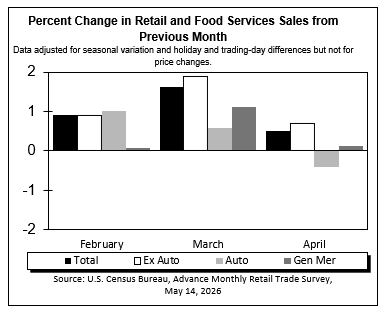
Source: Census Bureau
Gasoline station sales growth slowed to 2.8% MoM from 13.7%, mainly due to easier comparisons.
Among the other categories that saw markedly slower growth are:
- Health & personal care stores (0% Vs +1.1%)
- Clothing & clothing accessories (-1.5% Vs +0.5%)
- Department stores: (-3.2% Vs +4.9%)
- Furniture & home furnishing stores: (-2% Vs +2.6%)
- Building material & garden equipment: (+0.1% Vs +1.1%)
- Motor vehicle & parts: (-0.4% Vs +0.6%)
On the other hand, sales at food services & drinking place stores, non-store retailers, miscellaneous store retailers, sporting goods, hobby, musical, instrument & book stores improved.
Commenting on the report, economist Mohamed El-Erian said the April retail sales growth was driven by rising prices than by increased volume.
Jobless Claims Rise
Separately, the Bureau of Labor Statistics (BLS) reported that weekly jobless claims rose 12,000 week over week to 211,000 in the week ended May 9. Economists had expected jobless claims to increase to 205,000 from the originally reported reading of 200,000 for the previous week.
The four-week average, which smooths out volatility, increased to 203,750 from the previous week’s 203,000 (revised from 203,250).
Continuing claims, also referred to as insured unemployment and is calculated with a week’s lag, climbed 24,000 to 1.782 million in the week ended May 2 from 1.758 million in the previous week (revised from 1.766 million). The consensus estimate modeled a reading of 1.790 million. Continuing claims measure the number of people who have already filed an initial claim and who have experienced a week of unemployment and then filed a continued claim to claim benefits for that week of unemployment.
Takeaways for Traders
With the labor market and consumer spending, the main engine of growth, remaining resilient, a Federal Reserve rate cut appears to be off the table. The economy’s resilience may complicate the Fed’s path forward.
For markets, the implication is that interest rates could remain higher for longer. Treasury yields may stay elevated as traders push back expectations for rate cuts, while equities could face a more selective environment in which energy producers and defensive sectors outperform rate-sensitive growth stocks.
Read Next: US Stock Futures Climb as Trump-Xi Summit Opens; Retail Sales, Jobless Claims in Focus


