
A duo of labor market readings released Thursday confirmed that the labor market is holding up dispute the engulfing macro and geopolitical uncertainties. The U.S. stock futures trimmed a tiny bit of their losses amid the release of the reports, and yet traded notably lower.
The negative sentiment is attributable to the very little clarity the U.S. President Donald Trump offered on how the Iran war, which is into its 34th day, would pan out.
Jobless Claims Fall: A Labor Department report showed that the number of individuals claiming unemployment benefits fell 9,000 to 202,000 in the week ended March 28 versus the expected 212,000. The previous week’s reading was upwardly revised by 1,000 to 210,000.
The four-week moving average, which smooths the volatility, was at 207,750 compared to the upwardly revised average of 210,500 for the previous week.
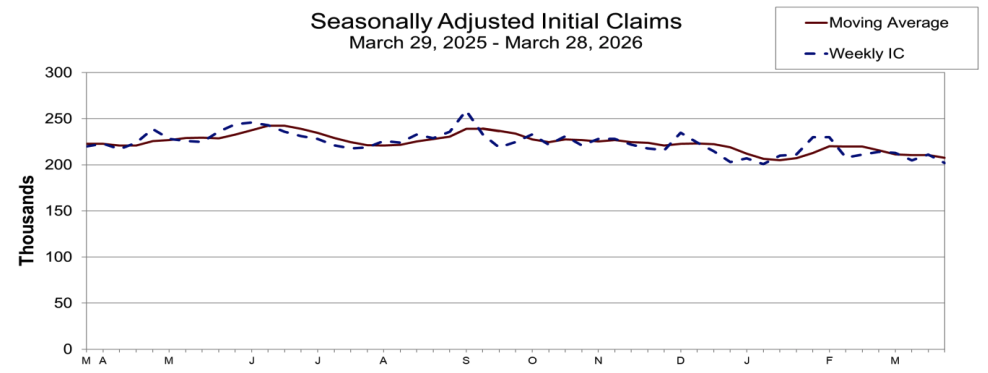
Source: Labor Department
Continuing claims, which is calculated with a week’s lag, came in at 1.841 million for the week ended March 21, up 25,000 from the previous week’s 1.816 million. This metric refers to the total number of people who are currently receiving unemployment insurance benefits and have filed for them for at least two consecutive weeks.
Layoffs Increase: A separate report showed that U.S. employers cut 60,620 jobs in March, marking a 25% increase from the 48,307 cuts in February. On a year-over-year basis, job cuts, however, fell 78%, according to the report compiled by global placement firm Challenger, Gray & Christmas. Much of the cuts in March this year happened in the technology, transportation and healthcare sectors.
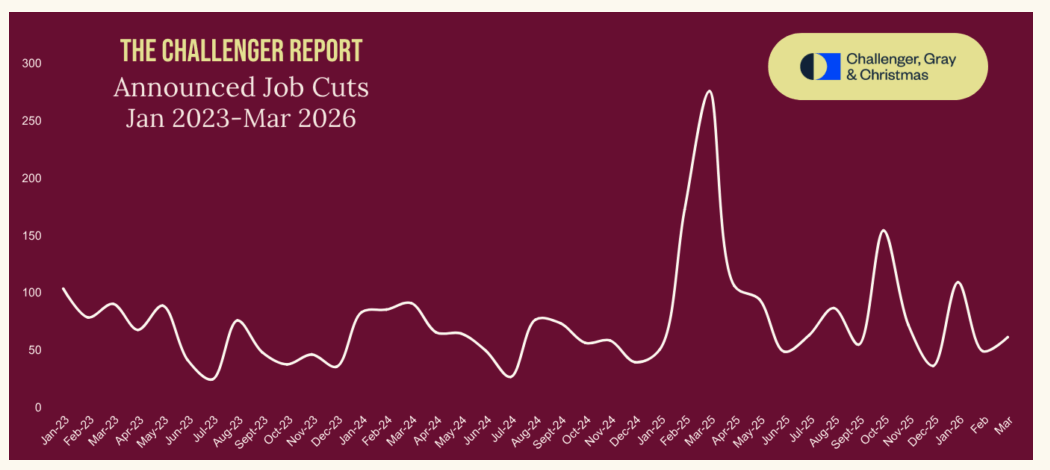
Source: Challenger, Gray & Christmas
The firm’s Chief Revenue Officer Andy Challenger said job cut patterns closely followed the pattern in 2025, excluding the wave of federal layoffs announced in the February-March period last year. “Companies are shifting budgets toward AI investments at the expense of jobs. The actual replacing of roles can be seen in Technology companies, where AI can replace coding functions,” he said.
“Other industries are testing the limits of this new technology, and while it can’t replace jobs completely, it is costing jobs.”
Oracle was the latest big tech company to lay off thousands of employees as it increases spending on data centers leveraged to AI applications.
On a positive note, the first-quarter total of 217,362 cuts were the lowest total since 2022.
Among other recent labor market data, ADP’s private payrolls report released Wednesday showed a bigger-than-expected increase in job gains in March, and the Bureau of Labor Statistics Job Openings and Labor Turnover Survey (JOLTS) survey showed a bigger-than-expected drop in job openings in February and hirings falling to a six-year low.
The focus now shifts to the monthly non-farm payrolls report for March due on Friday. Economists, on average, estimate payroll growth of 65,000 following a loss of 92,000 jobs in February.
Given the Federal Reserve focuses on the labor market, along with inflation, these numbers have a read-across for the central bank’s monetary policy decisions.
Read Next: US Stock Futures Crash After Trump’s National Address Adds More Confusion to Iran War


