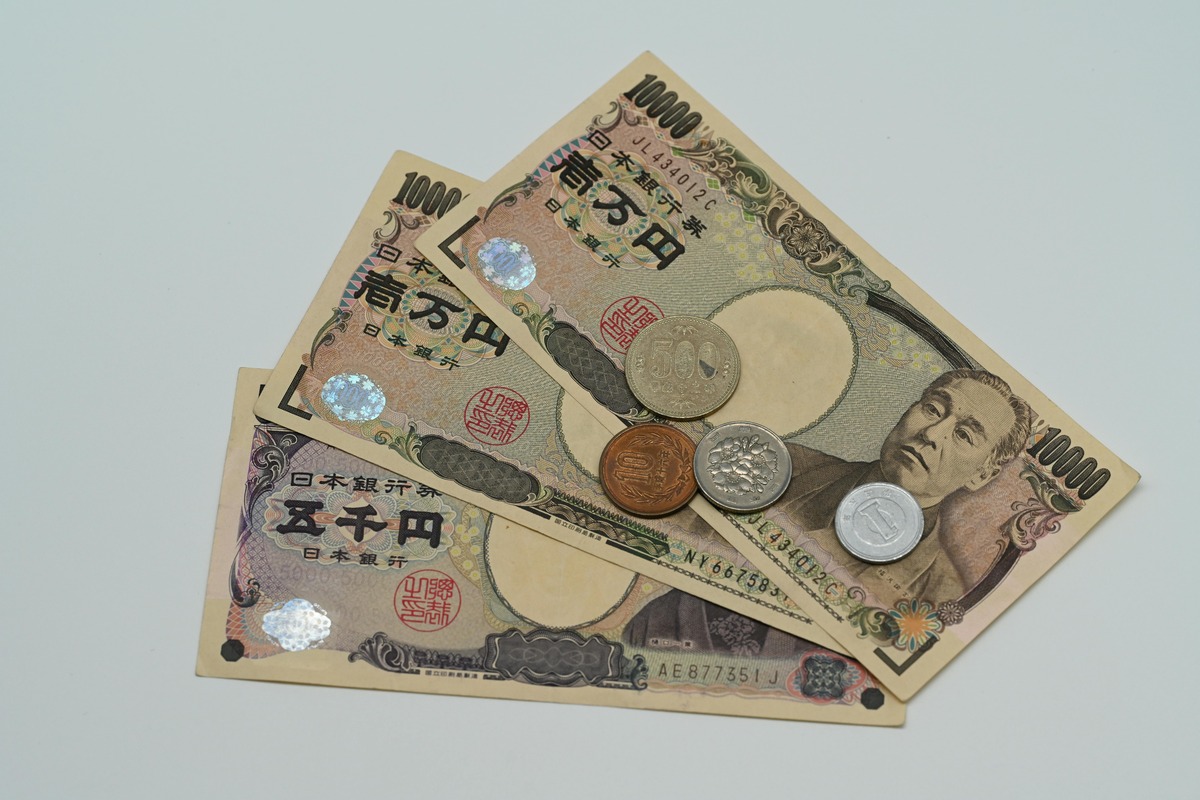
A 40-year high in dollar-yen has been built almost entirely on momentum and rate-gap positioning, and not on the unfolding week's policy outcomes, which both central banks are expected to leave unchanged.
USD/JPY is hovering near 164 per dollar after touching a fresh 40-year high of 163.9790 last Thursday. That kind of move would normally suggest a market bracing for a major policy shock. Instead, it's happening heading into a week where both the events that should matter most, namely Wednesday's Federal Open Market Committee (FOMC) meeting outcome and Friday's Bank of Japan rate decision, are expected to be non-events.
Consensus points to a Fed hold and a BoJ hold at 1%. When a pair is trending hardest right into two meetings the market doesn't expect to move the needle, that's worth exploring. It suggests the trend is being carried by something other than fresh fundamental information. And that's the real story of this week's setup.
Lloyd Financial Chief Market Strategist Colin Symons said the most likely Fed outcome is a "hold and monitor," which shouldn't have a big impact. It could be slightly negative for the dollar, he added
What's Actually Driving Price: Trend and Positioning
The technical chart shows USD/JPY remains in a healthy uptrend because investors are still comfortable borrowing cheap yen to buy higher-yielding dollar assets. As long as the Fed keeps interest rates much higher than the BoJ, that interest-rate advantage continues to support the dollar against the yen.
Once that kind of trend is established, systematic and trend-following flows tend to reinforce it independent of new information, which helps explain why the pair keeps grinding higher even without a fresh catalyst attached to each leg up. In short: this is a trend running on its own momentum, not on a string of surprising data points.
Positioning: Leveraged Funds and Asset Managers Both Adding to Yen Shorts
The Commodities Futures Trading Commission’s (CFTC) Commitment of Traders (COT) report as of July 21 shows leveraged funds, i.e., the speculative, trend-following crowd most relevant to a technical setup, holding 81,033 long yen contracts versus 177,218 short, a net short position of roughly 96,200 contracts. That's a firmly bearish yen stance, consistent with the USD/JPY uptrend. More telling is the change from the prior week: longs were essentially flat (+95) while shorts jumped by 5,819, meaning funds added net short exposure rather than trimming it.
Asset managers/institutional accounts tell a similar story at even larger scale: 72,045 long versus 151,951 short, a net short of about 79,900 contracts, and the week's change shows shorts up 23,510 while longs actually fell 2,579 — a meaningful swing further into net-short yen territory.
With leveraged funds and asset managers this stretched net short, the market has more fuel for a sharp squeeze higher in the yen if the Fed or BoJ delivers any dovish-for-dollar/hawkish-for-yen surprise, reinforcing that the bigger tail risk this week sits on the downside of USD/JPY, not the upside.
The Fundamental Gap Traders Are Ignoring
Here's the tension worth flagging directly: Japan's Ministry of Finance has repeatedly warned that authorities are prepared to take "decisive action" in the currency market if needed, and there have been reports that BoJ officials are open to tightening faster than markets currently anticipate. None of it has dented yen weakness.
The market keeps pushing the yen lower even after repeated intervention warnings. That tells you something: traders don't think Japan will actually act, just talk. It's a small but real fundamental judgment sitting underneath what otherwise looks like a purely technical trend.
Key Levels to Watch
With the fundamental calendar largely a non-event this week, the actual decision points for traders sit on the chart:
Resistance: The psychological 165 handle sits directly overhead, with some desks floating stretch targets into the 170 area if the trend extends cleanly through it.
Support: Prior consolidation zones built over recent weeks provide the first line of defense on any pullback, with the 200-day moving average further below as the level that would mark a genuine trend shift rather than a routine dip.
USD/JPY is trading at 163.68, holding a clean ascending channel that's been intact since the early-May low near 154. Price sits above all four moving averages in the ribbon (20, 50, 100, and 200-SMA), a textbook bullish stack confirming the uptrend across timeframes. The 14-day RSI reads 67.68, elevated and pressing toward the 70 overbought threshold, but not there yet. The momentum is strong without being stretched to breaking point. The channel's upper boundary lines up with immediate resistance near 164.23, while a break of the lower channel trendline and the rising 20-SMA (162.53) would be the first sign the current leg is losing steam, with the 50-SMA near 161.18 as the next real support test below that.
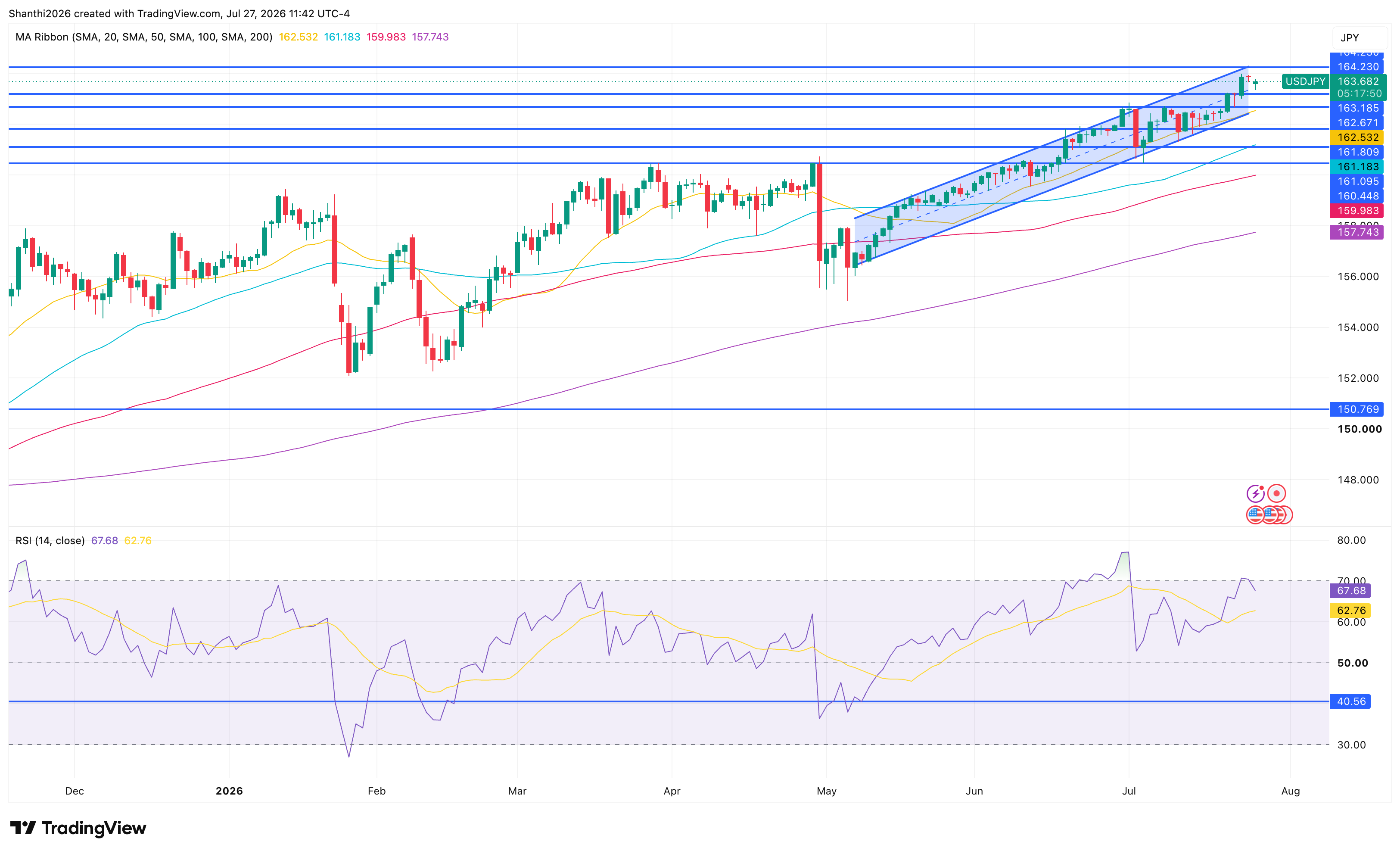
Source: TradingView
As long as price holds above near-term support, the path of least resistance stays higher, which suggests the technical setup, not the policy statements, is what's likely to actually move the pair day to day this week.
Lloyd Financial’s Symons said the USD/JPY pair, staying over 164 would be a sign this move can continue. “Staying below 163 suggests a wobble, with a sustained downtrend becoming a worry,” he added. The strategist flagged Japan continuing to fund itself through short-term debt as the main thing to watch. “As long as it does, the chances of more persistent market problems appear relatively small,” he said.
Why the Setup Into Wednesday Isn't Symmetric
It's worth being explicit that the risk around this week's Fed decision isn't evenly distributed. USD/JPY is stretched near multi-decade highs on a heavily one-sided carry trade: long dollar, short yen. That kind of positioning means a dovish surprise from the Fed carries outsized potential to trigger a sharp, disorderly unwind, the way a relatively modest BoJ hike in July 2024 sent the pair from 161 to 141 in three weeks as crowded positioning came undone all at once. A hawkish surprise, by contrast, would likely just extend a trend that's already priced in, more continuation than shock. In other words, if the Fed and BoJ deliver the expected decisions, USD/JPY is likely to continue edging higher. But if either central bank surprises the market, the bigger move is likely to be lower, as crowded bullish positions could unwind quickly.
Where Fundamentals Could Reassert Themselves
The technical trend can keep running as long as nothing forces a fundamental repricing — but there are three triggers worth watching.
- First, actual intervention: verbal warnings becoming real yen-buying in the market, rather than just rhetoric.
- Second, a hawkish surprise or shift in guidance at Friday's BoJ meeting that suggests officials are serious about a faster tightening path.
- Third, any Fed surprise — hawkish or dovish — that meaningfully narrows or widens the rate differential the carry trade depends on.
Any of those would interrupt a setup that, for now, is being driven almost entirely by chart structure and positioning rather than the two central bank decisions sitting directly in its path.