
Silver futures have broken above the key $65-$65.50 resistance zone and briefly traded above $67, but the pullback toward $66.90 leaves bulls facing a test of whether the breakout can develop into sustained upside momentum or a merely another intraday spike once the reaction settles.
$67 Breakout Meets Its First Test
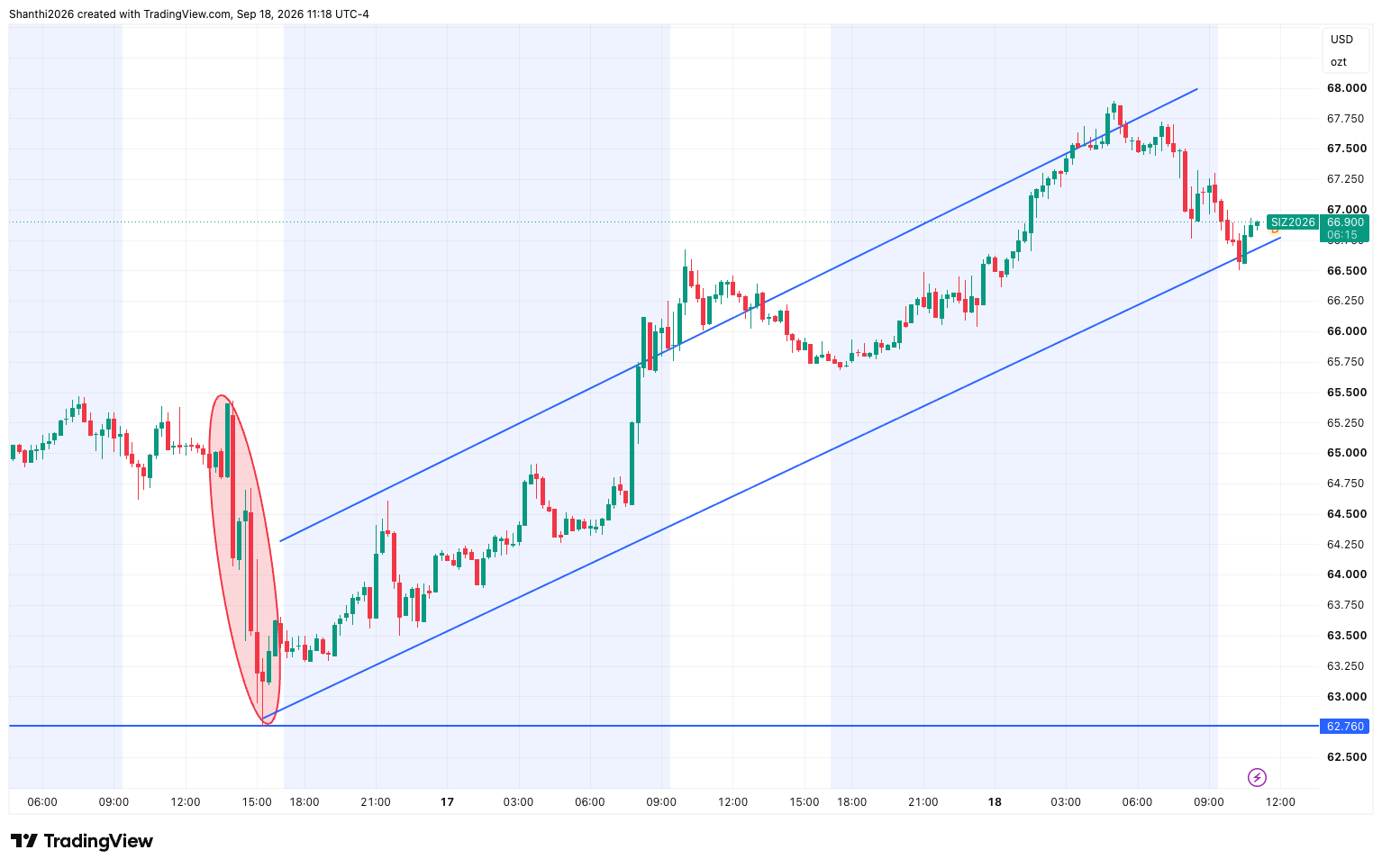
Silver pushed through $67 before recoiling to around $66.90 putting the psychological level at the center of the next move. The advance extends the breakout above the $65-$65.50 resistance zone highlighted in the previous setup.
The move also comes against a complicated macro backdrop. The Federal Reserve raised rates this week, putting upward pressure on borrowing costs. . The Federal Reserve raised rates this week, initially weighing on silver and sending prices down to $62.70. The metal then clawed back those losses and embarked on a broader uptrend, reaching a near-term peak around $67.90 during the early New York session Friday. The rally cooled shortly afterward, however, with silver retracing part of the move and slipping back below $67.
Source: TradingView
For silver, the direction of Treasury yields and the dollar remains important because higher real yields and a stronger dollar can weigh on non-yielding metals.
But this breakout has occurred despite dollar strength, rather than because of a weaker dollar. In the aftermath of the Fed decision, the U.S. Dollar Index (DXY) successfully challenged the 100 resistance level and climbed to its highest level since late July. Ordinarily, such a move would be expected to create a headwind for dollar-denominated silver, given the typical inverse relationship between the two assets.
That divergence may be more important than the price level itself. It suggests that factors beyond the dollar could be helping drive silver's advance, whether through real-yield dynamics, industrial demand, safe-haven flows or short-covering. The price action does not, by itself, establish which of these factors is dominant, but it does show that silver is absorbing a headwind that would normally weigh on the metal.
After easing on Thursday, the benchmark 10-year U.S. Treasury yield climbed back above 5% on Friday, making the silver rally harder to explain through the usual rate channel alone.
For now, price action is showing that buyers remain willing to step in despite those headwinds. The immediate question is whether they can reclaim $67 and turn the brief breakout into sustained momentum.
Bullish Positions Dominate
MarketFramework's Top Traded Contracts tool points to a strongly bullish positioning backdrop in e-mini Silver, with 80% of tracked positions currently long and only 20% short, resulting in a "Strong Long" seven-day lean. The data suggests traders continue to favor upside exposure in the precious metal, reflecting confidence that the broader trend remains intact. Such a pronounced long bias often accompanies periods of strong momentum, particularly when investors are seeking exposure to precious metals amid inflation concerns, geopolitical uncertainty, or expectations of a weaker U.S. dollar.
The crowd breakdown, however, offers a more balanced perspective. Winning traders are 55% long, while losing traders are 53% long, indicating that both profitable and unprofitable participants are largely positioned in the same direction. The absence of a meaningful divergence suggests the current bullish bias is being supported by successful traders rather than challenged by them.
At the same time, the overwhelming 82% long aggregate positioning highlights a potential contrarian risk. When sentiment becomes heavily one-sided, markets can become vulnerable to profit-taking or sharp pullbacks if fresh buying interest fails to materialize. While positioning continues to favor higher silver prices, the crowded nature of the trade means bullish momentum may increasingly depend on new catalysts to sustain further gains.
Fundamentals Still Matter
Silver has a dual identity that makes the fundamental backdrop particularly important. It trades as a precious metal alongside gold, but also has significant industrial demand exposure. That means expectations for global growth, manufacturing activity and investment in areas such as electronics and clean-energy technologies can influence the longer-term demand picture.
At the same time, the broader precious-metals complex remains sensitive to expectations for monetary policy, the dollar and geopolitical risk. Any renewed decline in yields or weakness in the dollar could provide another tailwind for silver, while a stronger dollar and higher yields could make it harder for bulls to sustain the breakout.
$65-$65.50 Becomes the Line to Watch
The technical picture has changed now that silver has moved through its earlier resistance zone. The $65-$65.50 area becomes important as potential support.
If silver holds above that zone despite the retreat from $67, the breakout structure remains intact. A deeper move back below it would weaken the bullish setup and raise the possibility that the move above $67 was a failed breakout.
That makes the next pullback particularly informative. Bulls do not necessarily need silver to surge immediately. They need buyers to defend the territory gained during the breakout.
$68-$68.30 Is the Next Hurdle
If silver reclaims $67 and momentum returns, attention can shift toward $68-$68.30, the next potential resistance area.
For futures traders, the setup has therefore evolved from watching whether silver could break $65 to determining whether it can build on that breakout: $67 is the immediate momentum test, $65-$65.50 is the key support zone, and $68-$68.30 is the next upside hurdle.
The fundamental backdrop could help determine whether the move has staying power, but for now, price action is sending the clearer signal. Silver has already broken higher. The next challenge is whether bulls can turn the brief move above $67 into a sustained advance rather than another rejection at resistance.