The Federal Reserve and Bank of Japan (BOJ) both raised interest rates this week, but the monetary-policy divergence that matters for currencies did not disappear. Instead, the dollar strengthened as investors interpreted the Fed's move as a more credible signal of further tightening, while the BOJ's hike failed to generate enough conviction that Japanese rates would rise quickly enough to support the yen.
The Fed raised its policy rate by 25 basis points on Wednesday to 3.75%-4.00%, its first increase since July 2023. The decision was unanimous, and the central bank said inflation remained elevated and that the move would support a "timelier" return to its 2% target. The Fed's projections also pointed to at least another rate increase in 2026.
Federal Reserve Vs. Bank of Japan: Benchmark Interest Rates
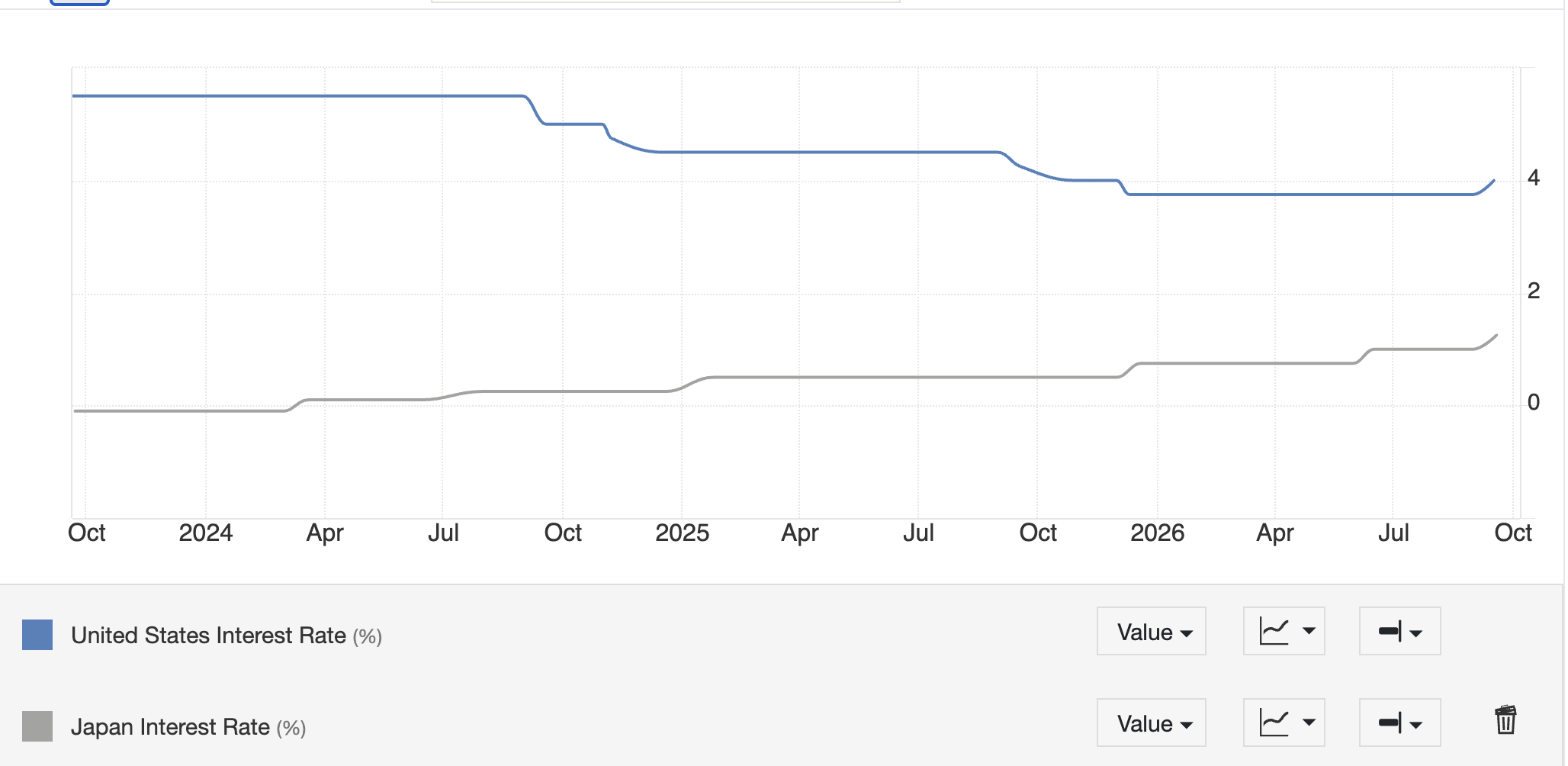
Source: Trading Economics
The dollar initially strengthened after the decision and reached a seven-week high as markets absorbed the prospect of additional U.S. tightening. The Dollar Index was around 100.44 on Friday, near its late-July high.
BOJ Hike Fails to Deliver a Yen Rally
The Bank of Japan followed with its own 25-basis-point increase on Friday, taking its policy rate to 1.25%, the highest level in 31 years. Governor Kazuo Ueda also indicated that the BOJ has shifted toward preventing inflation from overshooting its target, leaving the door open to additional tightening.
Yet the yen moved in the opposite direction.
The problem for yen bulls was that the hike was already widely expected. More importantly, the BOJ's decision was not unanimous: two policymakers opposed the increase. That dissent raised questions about how quickly the central bank can continue tightening. The yen subsequently fell to as low as 158.054 per dollar before recouping some of the losses.
That reaction illustrates an important currency-market distinction: a rate hike matters less when it is fully priced in than the guidance surrounding the next hike.
USD/JPY Rebound Runs Into Technical Resistance
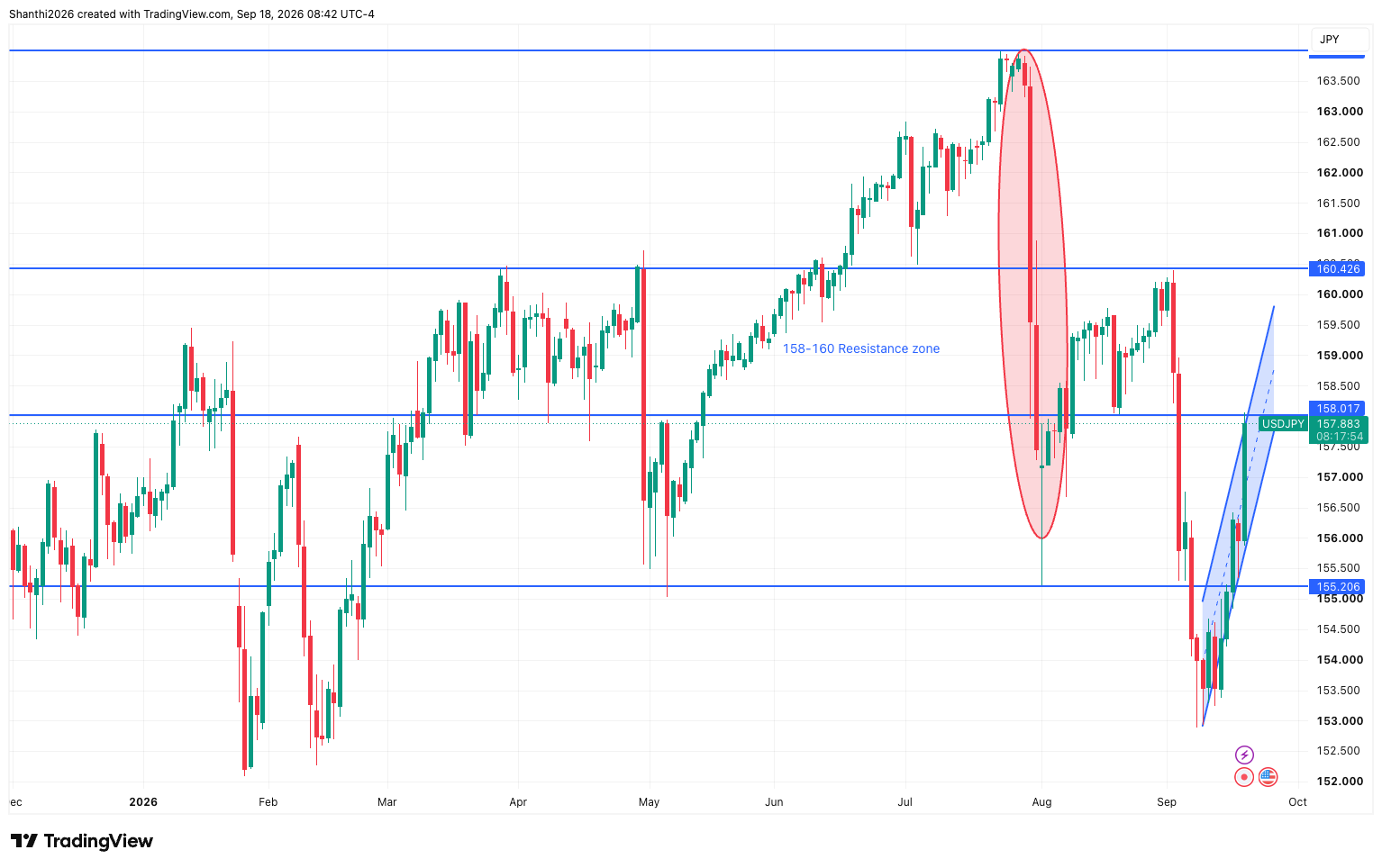
For USD/JPY, that shift in expectations is now being reflected in a sharp technical recovery that has brought the pair back toward a major resistance zone.
After peaking near 164.00 in July, USD/JPY sold off toward 155.00 in August before making another lower low around 153.00 in early September. That sequence established a lower-high/lower-low structure, signaling a broader bearish shift before the latest rebound.
The current sharp V-shaped relief rally from the 153.00 low has rapidly pushed the pair back toward 158.00. That move is now testing the 158.00–160.00 zone, which previously served as support before the August-September breakdown and could therefore become significant overhead resistance.
Source: TradingView
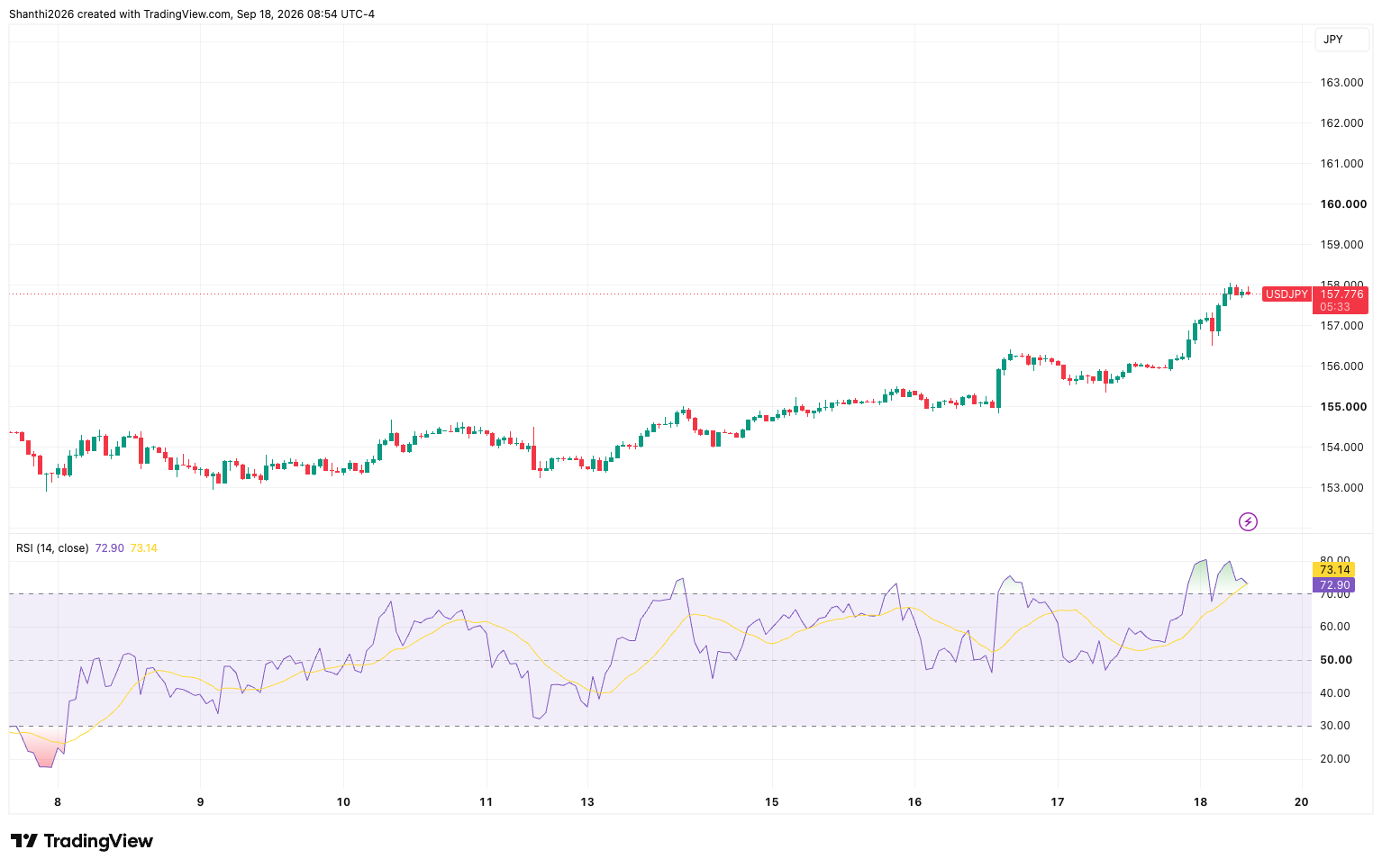
The 1-hour USD/JPY chart provides additional confirmation of the rebound, with price clearing local resistance around 156.00–156.50 and sustaining bullish momentum. This upward shift is confirmed by a recent Golden Cross, where the 100-period SMA crossed above the 200-period SMA, creating a potential dynamic support zone beneath price.
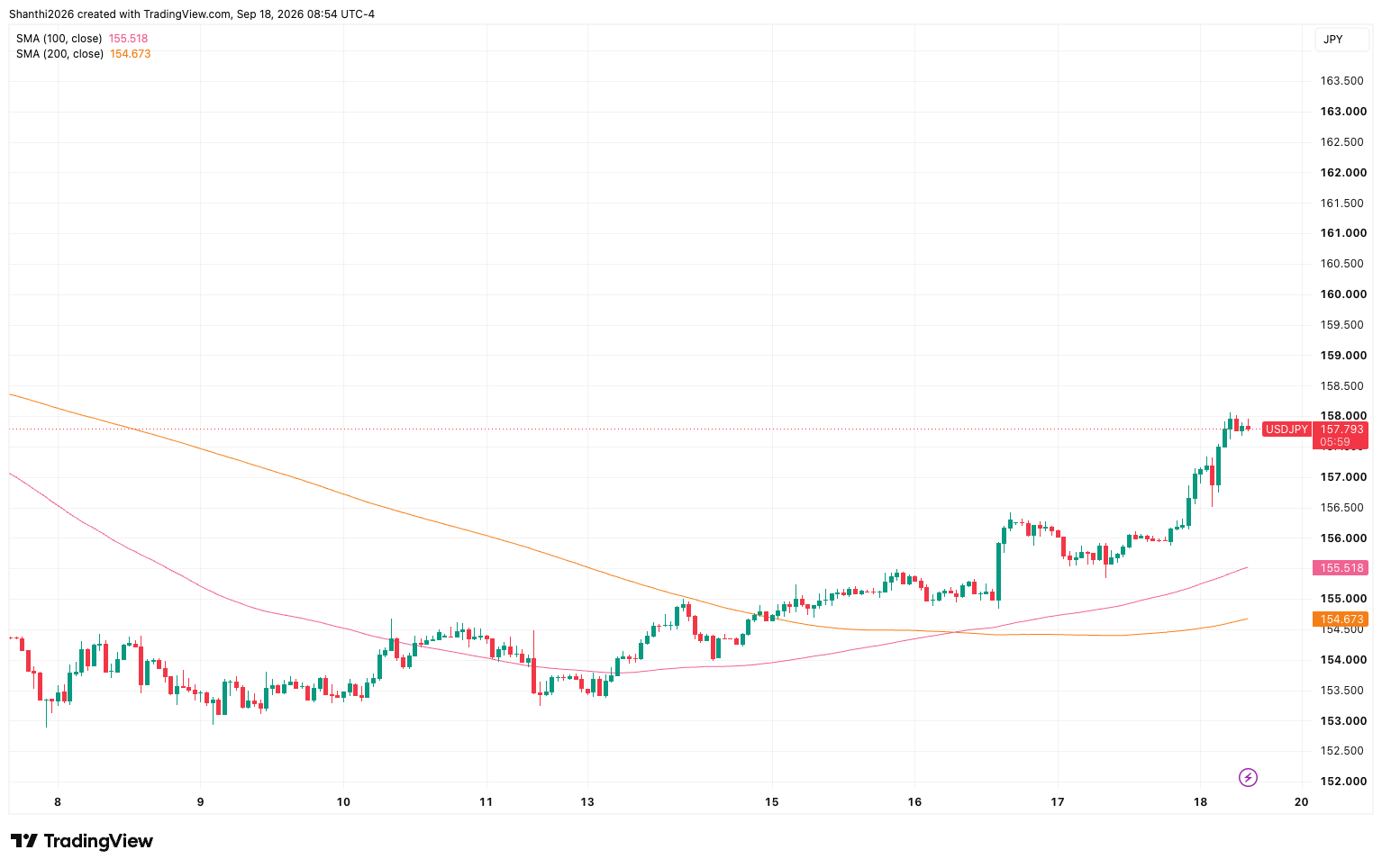
Source: TradingView
However, with RSI above 70 and entering overbought territory, the move is becoming stretched as price approaches 158.00 resistance. A pullback toward the 156.50–157.00 breakout zone would allow momentum to cool and give traders a clearer area to assess whether the breakout can hold, with the 158.50–160.00 region remaining the next major resistance area.
Source: TradingView
The Session VWAP chart reinforces the short-term bullish momentum. USD/JPY has been trading near the Upper Standard Deviation Band at 157.746 after breaking above the central VWAP at 157.150 during the move from 156.00 toward 158.00. The latest pullback is testing the upper band around 157.669.
As long as price remains above the 157.150 VWAP, the intraday structure remains constructive. A deeper retracement toward 157.150, or potentially the lower band near 156.554, would bring price back toward the broader support zones identified on the 1-hour chart.
Source: TradingView
The 6J Japanese yen futures positioning adds another layer to the dollar-yen story. MarketFramework’s Top Traded Contracts tool shows the current lean as neutral, with 0% long and 0% short, but the crowd split shows 86% of winning trades are short compared with 67% of losing trades. That suggests profitable traders have been more heavily positioned for yen weakness, consistent with the recent rise in USD/JPY. The setup therefore provides a positioning-based confirmation of the currency market's reaction to the BOJ hike, although the neutral current-day lean means the signal is not an outright directional call.
The Fed-BOJ Rate Gap Still Matters
Even after this week's two hikes, the interest-rate differential remains enormous. The Fed's target range is now 3.75%-4.00%, compared with the BOJ's 1.25%.
More importantly, the Fed entered the week with a stronger inflation-fighting message. Fed Chair Kevin Warsh emphasized persistent inflation, while the central bank's projections kept another increase on the table.
The BOJ, meanwhile, raised rates but left investors looking for clearer evidence that another increase would come quickly. The yen's decline reflected doubts about the pace of future tightening, despite Governor Ueda's more inflation-focused message.
That leaves the dollar with an advantage that is not simply about today's policy rates. It is about the expected path of rates.
US Yields Add Another Layer of Dollar Support
The bond market reinforced the currency move. The U.S. 10-year Treasury yield briefly moved above 5% this week, its highest level since 2007, before retreating toward 4.93%.
Higher U.S. yields can make dollar-denominated assets more attractive relative to lower-yielding alternatives, particularly when investors believe the Fed is willing to keep policy restrictive to contain inflation.
That dynamic is especially important for USD/JPY. A BOJ hike theoretically narrows the U.S.-Japan yield gap, which should support the yen. But if U.S. yields remain elevated while investors doubt the speed of additional Japanese tightening, the narrowing may not be large or durable enough to reverse dollar demand.
Oil and Inflation Complicate the Picture
The broader inflation backdrop also favors the dollar's safe-haven and yield-support channels. Middle East tensions have kept oil prices above $100 a barrel for much of the week, increasing pressure on central banks to respond to renewed inflation risks.
That creates an unusual environment in which higher energy prices can simultaneously push central banks toward tighter policy and increase demand for the dollar through safe-haven flows.
For the BOJ, the problem is particularly complicated. Higher energy costs can lift Japanese inflation while also hurting an economy heavily dependent on imported energy. That makes the pace of future tightening less straightforward than the headline rate increase suggests.
What the Dollar's Weekly Win Says About Markets
The week's message is therefore less about Fed versus BOJ and more about Fed credibility versus BOJ expectations.
The Fed delivered a hike and reinforced the possibility of another. The BOJ delivered a hike that was already expected, but its internal split made the future path less certain. The result was a sharp reversal in the yen and renewed strength in the dollar.
For currency traders, the next question is whether the dollar can sustain its move above the 100 area on the Dollar Index and whether USD/JPY can hold above the 157 zone. A continued rise in U.S. yields would reinforce the dollar's rate advantage, while clearer signals of additional BOJ tightening could challenge it.
For now, this week's central-bank decisions have produced a counterintuitive result: both the U.S. and Japan tightened, but the currency market treated the Fed's hike as the more consequential signal.
Near-Term Catalysts for USD/JPY
Attention now turns to U.S. Treasury yields, Japanese inflation and U.S. PCE and labor data for clues on the next Fed and BOJ moves. Higher U.S. yields could support USD/JPY, while stronger Japanese inflation could boost BOJ hike expectations and support the yen. Oil prices remain a two-way risk, while Japanese intervention concerns could cap further yen weakness if USD/JPY climbs sharply.