
Gold is attempting to stabilize above $4,200 after a sharp sell-off pushed the metal toward $4,140 earlier this week, putting the focus squarely on whether the latest rebound represents genuine buying interest or merely a temporary relief move.
The timing is critical. Investors are preparing for the latest U.S. personal consumption expenditures (PCE) inflation data, the Federal Reserve's preferred inflation gauge, which could reshape expectations for the path of interest rates.
Consensus PCE Inflation Expectations
| Metric | August (Consensus) | July (Actuals) |
|---|---|---|
| PCE inflation (M-o-M) | +0.4% | +0.2% |
| PCE inflation (YoY) | +3.7% | +3.7% |
| Core PCE inflation (M-o-M) | +0.3% | +0..2% |
| Core PCE inflation (YoY) | +3.3% | +3.3% |
For gold, the reaction may extend beyond the inflation number itself. Treasury yields and the U.S. dollar could determine whether the metal can build on its recovery or faces another wave of selling.
PCE Could Decide Whether $4,200 Holds
A hotter-than-expected inflation reading could reinforce expectations that the Fed will have limited room to ease policy, particularly with energy prices adding to inflation concerns. Higher yields and a firmer dollar would raise the opportunity cost of holding non-yielding gold.
That would put the $4,200 area back under pressure and potentially expose the recent lows around $4,140.
A softer PCE reading would offer the opposite setup. If inflation shows signs of cooling, Treasury yields could ease and rate-cut expectations could receive a boost, potentially allowing gold buyers to regain control.
The key question is whether the metal can sustain gains after the initial PCE reaction rather than simply spike on the headline.
Gold's Rebound Has Improved, But Higher-Timeframe Trend Not Yet Bullish
The technical picture presents a clear conflict between the higher and lower timeframes.
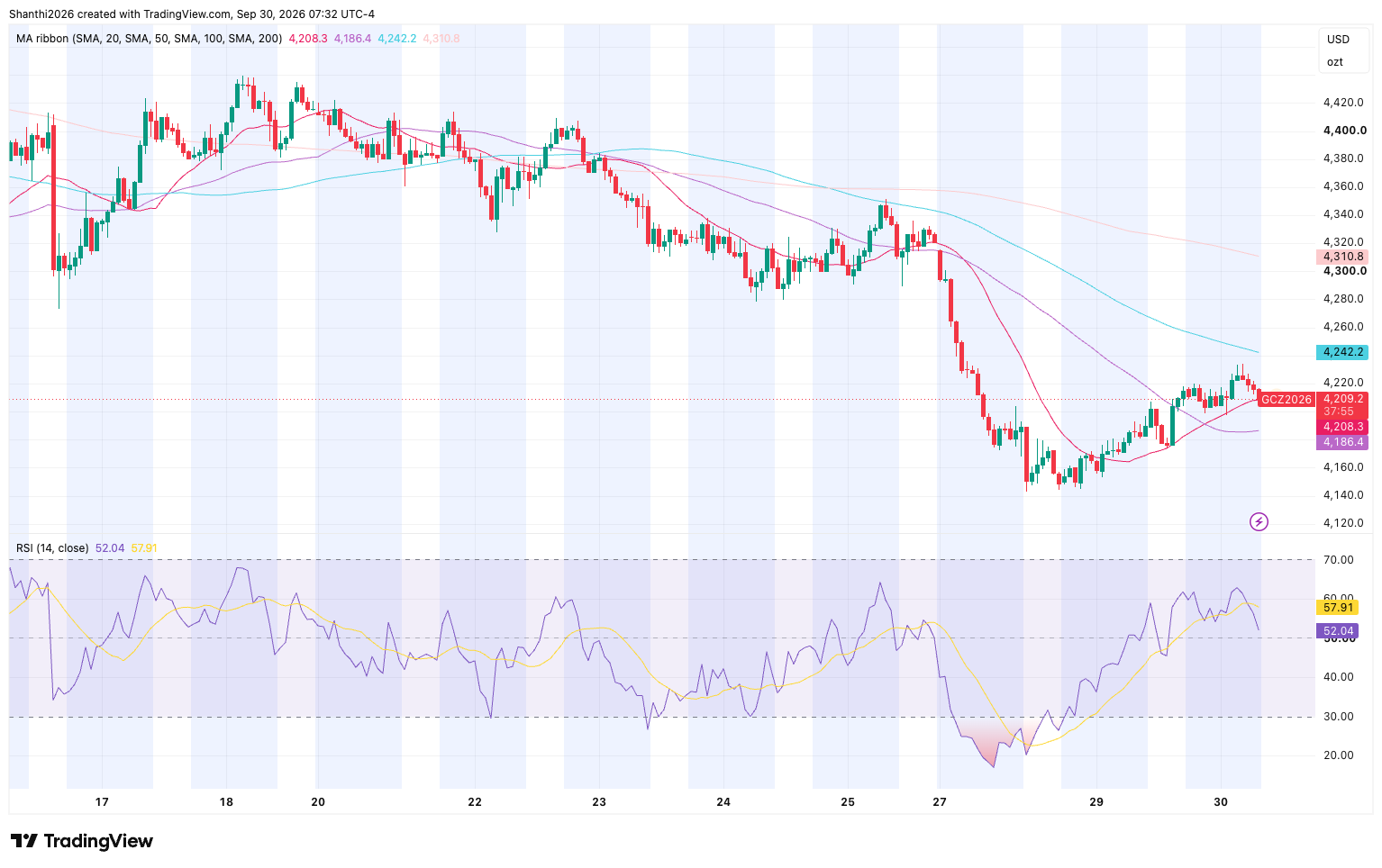
On the higher-timeframe chart, gold remains in a broader bearish correction after falling sharply from highs above $4,400 to a swing low in the $4,140-$4,160 region. Although the metal has rebounded from those lows, it remains below its major overhead moving averages, with the 100-day SMA at $4,242.2 and the 200-day SMA at $4,310.8.
Source: TradingView
That keeps the broader structure bearish to neutral, despite the recent stabilization.
Momentum, however, has improved materially. The 14-period daily RSI has recovered from deeply oversold territory below 20 to 52.04, suggesting that the aggressive selling pressure that drove the latest decline has subsided for now.
This creates an important distinction: the rebound has repaired momentum, but it has not yet repaired the higher-timeframe trend.
Lower Timeframes Show a Bullish Recovery Structure
The intraday chart is more constructive.
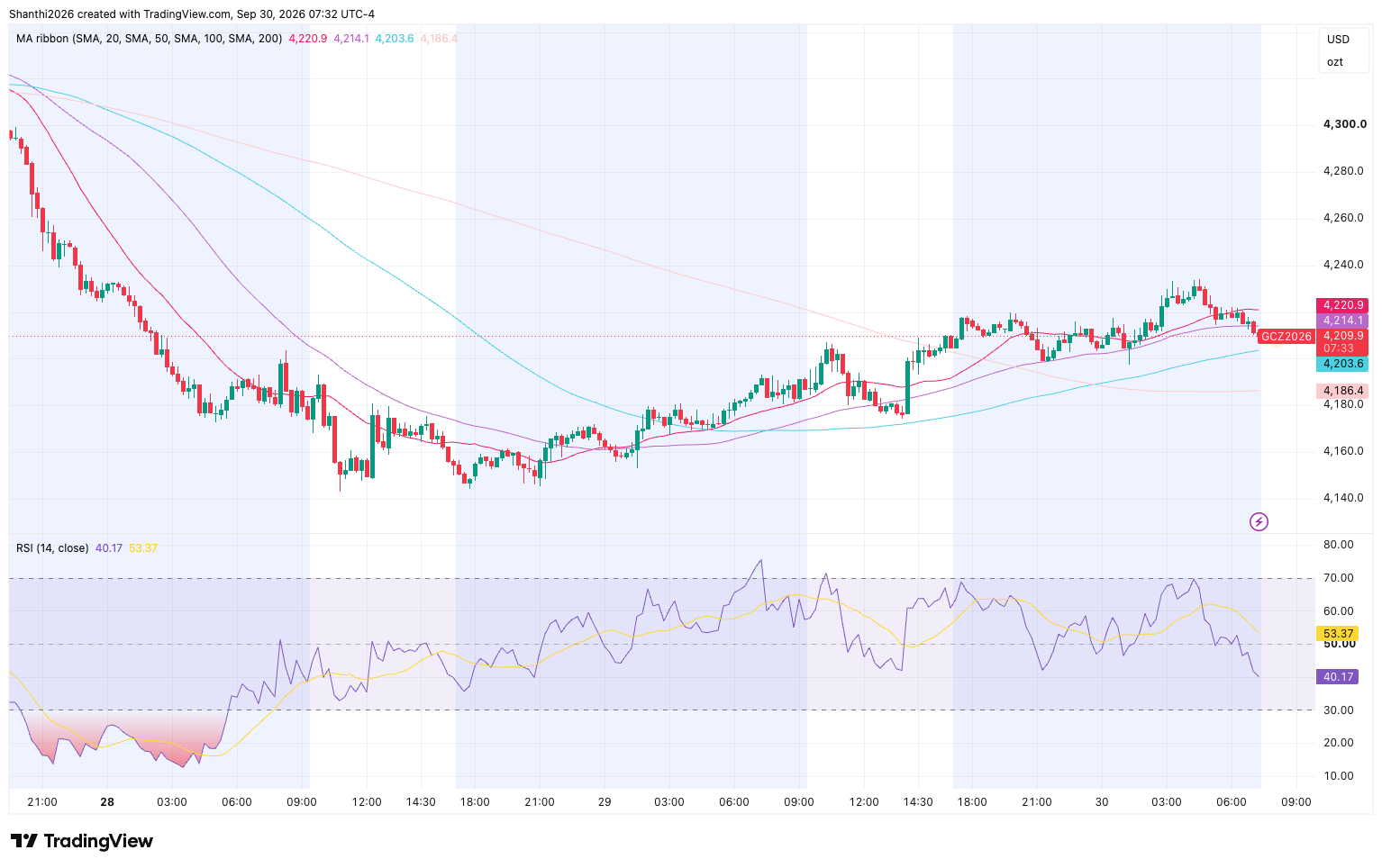
Gold has formed a sequence of higher lows from the $4,140 base and climbed toward a local high near $4,230 before pulling back toward $4,209-$4,210.
Short-term moving averages currently favor the recovery. Price remains above the 50-period SMA at $4,203.6 and the 100-period SMA at $4,186.4, although it is now testing immediate resistance around the 20-period SMA at $4,220.9.
Source: TradingView
The intraday RSI has cooled to 40.17 after previously approaching 70. That reset indicates that short-term momentum has weakened, but it does not by itself invalidate the broader intraday recovery.
The key is whether buyers defend the $4,203.6 and $4,186.4 support layers.
Positioning Adds a Bullish Signal
Futures positioning provides another constructive signal for the recovery. MarketFramework’s Positioning Edge shows Micro Gold futures (MGC) with an Extreme Bullish Divergence, with profitable traders 75% long compared with 33.3% among unprofitable traders. Overall positioning is 46.2% long, meaning the bullish bias is concentrated among traders with the stronger recent trading performance.
The divergence is notable because it suggests that traders who have been more successful are leaning substantially more bullish into the rebound. With MGC volatility also up 23%, however, the signal comes alongside a more active trading environment rather than a low-risk recovery.
$4,242 Is the Next Major Technical Test
The technical setup creates a relatively clear roadmap for the PCE reaction.
A sustained hold above $4,203.6 would keep the short-term recovery structure intact. Holding the deeper $4,186.4 support would provide additional confirmation that buyers remain engaged.
A move back above $4,220.9 would strengthen the near-term momentum picture and put the higher-timeframe 100-day SMA around $4,242.2 directly in focus.
That level is particularly important because it represents both a major moving-average barrier and the next test of whether the current rebound can transition into a more meaningful recovery.
Conversely, a break below $4,186.4 would weaken the lower-timeframe bullish structure and shift attention back toward the $4,140-$4,160 swing-low zone.
3 Scenarios for Gold After PCE
| Scenario | Marker Reaction | Gold Implication |
|---|---|---|
| Hot PCE | Yield and dollar rise | $4,200 under pressure; break below $4,186.40 could expose $4,140-$4,160 |
| In-line PCE | Limited move in yields/dollar | Gold likely to consolidate between $4,186-$4,230 |
| Soft PCE | Yields and dollar retreat | Gold could reclaim $4,220.90, potentially challenging 100-day SMA ($4,242.20) |
Recovery or Dead-Cat Bounce?
Gold's reclaim of $4,200 is significant, but the technical structure argues against treating it as confirmation of a full trend reversal just yet.
The lower-timeframe setup has turned constructive, with higher lows and price above the 50- and 100-period intraday SMAs. At the same time, the higher-timeframe trend remains constrained by the $4,242.2 100-day SMA and $4,310.8 200-day SMA.
That leaves $4,200 as the immediate battleground and $4,242 as the more important test of recovery strength.
PCE could determine whether gold breaks through those barriers or loses its footing again. A sustained move above $4,242.2 would materially improve the technical picture, while a failure to hold $4,186.4 would put the 4,140-4,160 swing low back in focus.